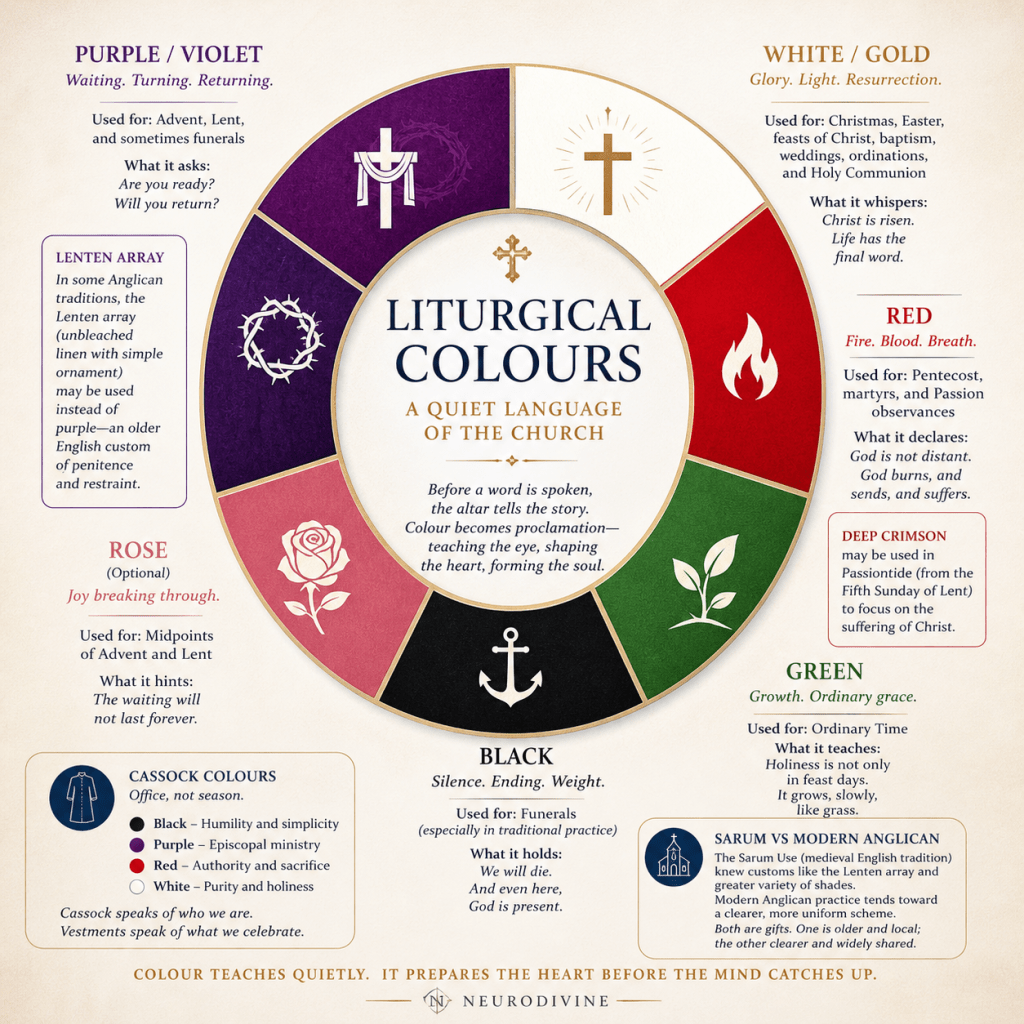
Liturgical colours are not decoration.
They are a form of speech.
Before a word is spoken, before a hymn is raised, the altar already tells the story.
Cloth and colour become proclamation—subtle, steady, faithful.
Across the historic churches—Catholic, Anglican, and Orthodox in their own ways—colour has long served as a quiet catechism: forming the eye, shaping the heart, and teaching the soul to recognise the seasons of God.
THE COLOURS AND WHAT THEY SAY
WHITE (or GOLD)
Glory. Light. Resurrection.
White is the colour of morning—of the stone rolled away, of linen folded, of the world made new.
Used for:
- Christmas and Easter
- Feasts of Christ
- Baptism, weddings, ordinations
What it whispers:
Christ is risen.
Life has the final word.
RED
Fire. Blood. Breath.
Red is flame and cost together—the Spirit descending, the martyr standing.
Used for:
- Pentecost
- Feasts of martyrs
- Passion observances (in some traditions)
What it declares:
God is not distant.
God burns, and sends, and suffers.
A deeper note:
In some Anglican and Catholic settings, a deep crimson may be used in Passiontide—the closing stretch of Lent—to draw the eye more closely to the suffering of Christ. The colour deepens as the story darkens.
PURPLE (or VIOLET)
Waiting. Turning. Returning.
Purple is the colour of thresholds—of roads not yet finished, of prayers still forming.
Used for:
- Advent
- Lent
What it asks:
Are you ready?
Will you return?
An older English echo:
In some places, especially where older customs are remembered, the Lenten array replaces purple.
Unbleached linen, plain and honest, sometimes marked with red or dark ornament—less a colour than a quiet refusal of colour.
It does not announce repentance.
It simply inhabits it.
GREEN
Growth. Ordinary grace.
Green is the colour of fields, of hedgerows, of the long middle stretch of the year where most of life is lived.
Used for:
- Ordinary Time
What it teaches:
Holiness is not only in feast days.
It grows, slowly, like grass.
BLACK
Silence. Ending. Weight.
Black is not despair—it is honesty.
Used for:
- Funerals (especially in traditional practice)
What it holds:
We will die.
And even here, God is present.
ROSE (Optional)
Joy breaking through
A soft interruption—light entering discipline.
Used for:
- Midpoints of Advent and Lent
What it hints:
The waiting will not last forever.
CASSOCK AND VESTMENT: TWO DIFFERENT LANGUAGES
The cassock speaks of office.
The vestment speaks of mystery.
- The cassock tells us who stands before us
- The stole and chasuble tell us what is being revealed among us
They should not be confused.
COLOUR IN THE LIFE OF WORSHIP
At a wedding, white does not decorate—it rejoices.
At a baptism, it does not adorn—it proclaims new birth.
At the Eucharist, it gathers sacrifice and victory into one table.
In Lent, purple—or the quieter Lenten array—draws us inward.
In Easter, white throws the doors open.
In Pentecost, red reminds us that the Church is not a museum, but a people set alight.
Even in funerals, the choice of colour becomes theology:
black for grief,
purple for penitence,
white for resurrection hope.
A NOTE ON SARUM AND MODERN ANGLICAN PRACTICE
The Church of these islands once knew a richly textured pattern of colour in what is often called the Sarum Use—a local medieval expression of the Roman rite, shaped by English life and devotion.
That inheritance lingers.
- The Lenten array belongs to that older world
- Distinctions of shade and season were often more fluid, more symbolic, less systematised
Modern Anglican practice, shaped by later Roman standardisation and global consistency, tends toward a clearer, more uniform scheme:
purple for Lent, green for Ordinary Time, white for feasts.
Neither is “more correct.”
One is older and local; the other clearer and widely shared.
Where the older customs remain, they offer something valuable:
a reminder that liturgy once grew from the soil of a place, not only from books.
PRACTICAL WISDOM
- Let colour serve the liturgy, not distract from it
- Keep consistency within your parish or diocese
- When in doubt, follow the appointed colour of the day
- Use older customs thoughtfully, not as novelty
Above all:
let the colour mean something
FINAL REFLECTION
Before the sermon, before the hymn, before even the greeting—
the altar has already spoken.
Colour teaches quietly.
It prepares the heart before the mind catches up.
Over time, the faithful begin to recognise it instinctively:
purple draws them inward
white lifts their gaze
red unsettles and sends
green steadies them again
And so the Church is formed—not only by words, but by seeing.
At the altar, nothing is accidental.
Not even the colour.


 NeuroDivine
Leave a comment