In much of Christian spirituality, waiting is treated as a virtue—Advent waiting, prayerful waiting, hopeful waiting. But that language can sometimes feel abstract, almost decorative. It does not always account for the body. For the nervous system. For the long fluorescent hours in hospital wards. For the way time stretches, distorts, or presses against the ribs when you are neurodivergent.
Waiting was written from within that embodied reality.
For those of us who are neurodivergent, waiting is rarely neutral. Anticipation can flood the system. Uncertainty can feel physically loud. Transitions are not gentle doorways but thresholds that scrape. Medical systems, train timetables, social cues, transplant lists—they ask for patience in ways that often disregard sensory intensity, pattern-thinking, or the deep need for clarity.
And yet Scripture is saturated with waiting.
“Those who wait upon the Lord…”
The groaning of creation in Romans.
The long silence between prophets.
The women waiting at the tomb before dawn.
Waiting, biblically, is not passivity. It is charged space. It is the tension between promise and fulfillment. It is the place where the body learns that hope is not the same as control.
In this poem, waiting happens beside railway tracks and dialysis pumps, in cafés and winter fields, along the slow bend of the River Barrow. God is not encountered in spectacle but in repetition—in breath, in landscape, in the steady hum of machinery that keeps a body alive. The holy is not elsewhere. It is here, in the ordinary endurance of a nervous system learning not to flee its own uncertainty.
Neurodivergent spirituality often carries an acute sensitivity—to light, to pattern, to sound, to atmosphere. That sensitivity can make waiting harder. But it can also make it sacramental. The hum of a ward becomes a litany. The rhythm of a pump becomes a kind of psalm. The bending river becomes theology: movement without haste, persistence without violence.
Waiting, in this sense, is not wasted time.
It is formation.
It is the slow shaping of trust in a body that would rather resolve the tension immediately. It is learning that God is present not only in arrival but in suspension. Not only in healing, but in the long in-between.
This poem does not romanticise waiting. It names its weight. But it also gestures toward something steady beneath it: a pulse kept in time with a patient land, a God who does not rush the river, and a hope that can inhabit even the four-hour chair.
To wait, then, is not to disappear.
It is to remain—attentive, embodied, and, in its own quiet way, divine.
I wait beside the Monasterevin train,
Cold rails in morning light;
The platform hums its soft refrain
Before the day takes flight.

I wait for tea and buttered bread,
For plates that never rush;
The café’s clatter overhead
Becomes a kind of hush.

I wait within the ward’s warm hum,
The pump begins its claim;
Four hours to let the cleansing come
And thin the thickened frame.

I wait for love in quiet ways,
In glances soft and kind;
In window seats on rain‑washed days
Where hands might be aligned.

I wait for God in whispered breath,
In fields near Emo’s rise;
In bog‑cotton and winter heath
Where silence testifies.

I wait for death without a fear,
A neighbour on the lane;
Not welcome yet, but always near
As dusk on Laois’s plain.

And still I wait, and still I stand
Where roads and rivers meet;
The Barrow bends through patient land
And keeps my pulse in beat.
Copyright 2026 Michael McFarland Campbell.
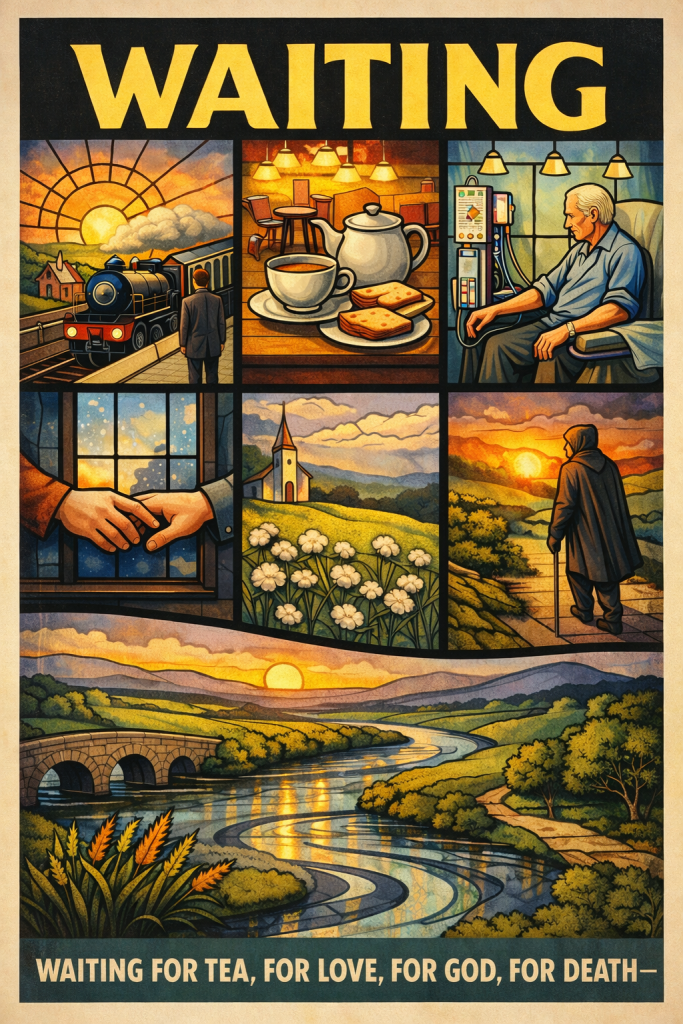
A 1950s-style illustrated poster titled “WAITING” in large golden-yellow block letters at the top. Below the title are six framed scenes arranged in a grid: a sunrise over a rural train station with a steam locomotive and a lone man on the platform; a café table with a teapot, cup, and buttered toast under warm hanging lights; an older man seated beside a dialysis machine in a hospital ward; two hands reaching toward each other across a window lit by evening sky; a small country church set among green hills and white wildflowers; and a cloaked figure with a walking stick looking toward a glowing sunset. At the bottom, a wide panel shows a river winding through a green landscape with a stone bridge under a setting sun. A tagline reads: “WAITING FOR TEA, FOR LOVE, FOR GOD, FOR DEATH—”. The colors are bold and slightly muted, with a textured, mid-century print feel.


 NeuroDivine
Leave a reply to fortunately37094ed5aa Cancel reply