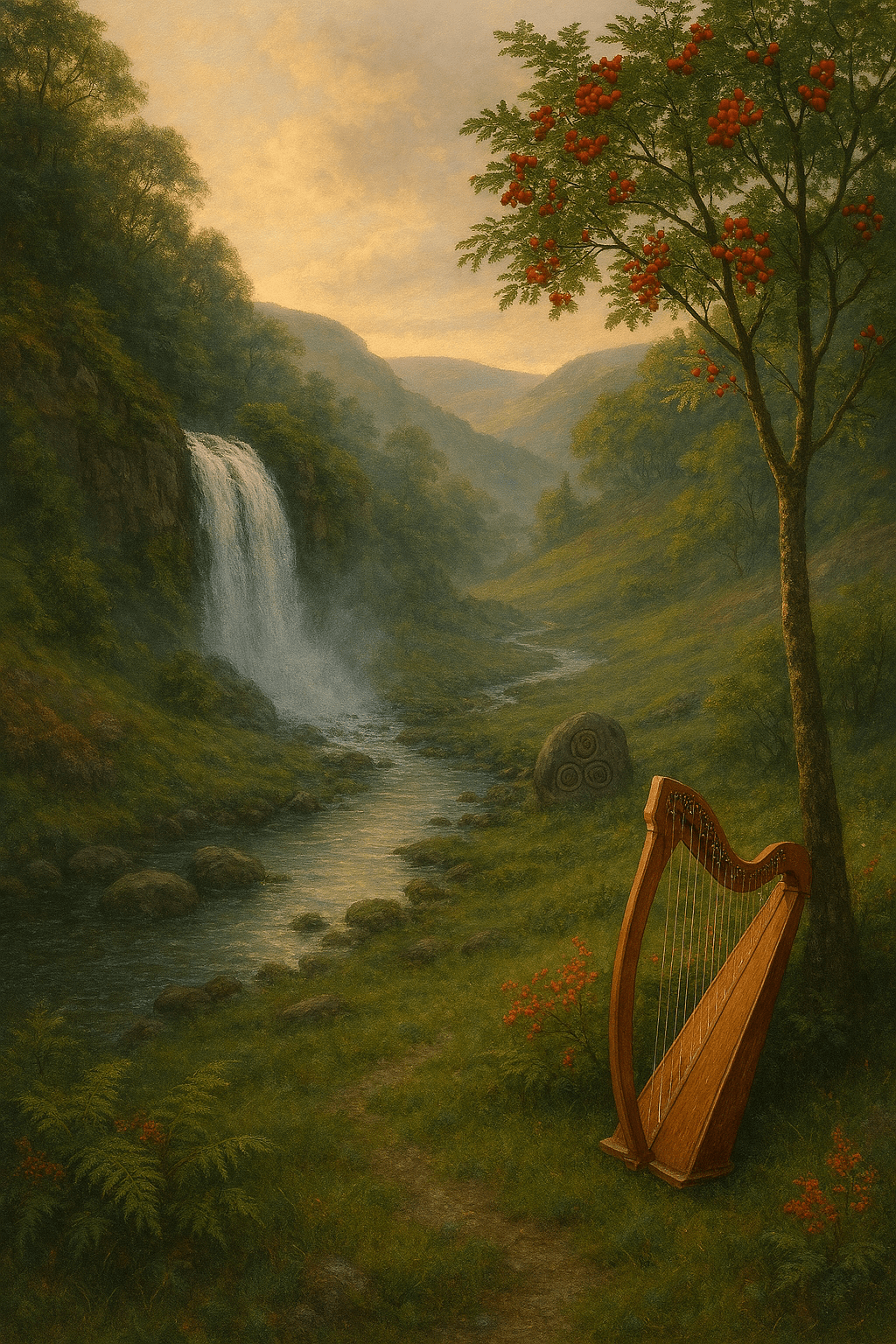
There are moments when ancient scripture meets the landscapes that formed us, and something quietly transformative happens. This newly written hymn, inspired by Psalm 137, does exactly that—taking the ache of exile and setting it among the Glens of Antrim, where memory, belonging, and spiritual resonance run deep.
Rather than retelling the psalm’s sorrow in a distant key, the hymn reframes exile through places many of us know in our bones: Glenariff’s soft veils of morning, the braes above the Braid, the heights of Slemish, the tide at Cushendun, the heathered hush of Glenann, the roar of the sea at Garron Point. These are not just locations—they are sensory anchors, grounding points, and “thin places” where the sacred feels near enough to touch.
For many neurodivergent people, spirituality is profoundly embodied and place‑rooted. Memory lives in textures, sounds, and landscapes. This hymn honours that truth. It lets the land itself become a companion in grief, a teacher in exile, and a guide toward hope.
- The rowan berries become blessings held gently in the hand.
- The triskele becomes a map of time, turning past and future into a present moment of grace.
- The standing stones become keepers of names, holding space for return.
- The bells of Ballycastle become a call toward peace, grounding, and homecoming.
Psalm 137 is often remembered for its raw lament—the pain of displacement, the struggle to sing in a strange land. This hymn doesn’t soften that grief, but it does something profoundly healing: it lets the landscape participate in the lament, and then in the restoration. Sorrow is braided into song. Exile becomes a teacher. Hope circles back like the tide.
For the NeuroDivine community, this is a reminder that:
- Our spiritual lives are allowed to be sensory, local, and embodied.
- Our memories—even painful ones—can be held with tenderness.
- Our journeys may spiral rather than follow straight lines.
- Homecoming is not always a place; sometimes it is a way of being gathered back into ourselves.
This hymn is a gift for anyone who has ever felt far from home, far from belonging, or far from their own voice. And it is a reminder that God’s presence threads through every glen, every stone, every tide—shaping us, steadying us, and calling us home again.
By the waters of Glenariff
By the waters of Glenariff,
where the veils of morning fall,
we remembered Zion’s heartbeat
in the river’s ancient call.
For the songs we learned in childhood
rose like incense from the shore;
in this glen, a thin place opened—
home was nearer than before.
From the heights of holy Slemish
to the tide at Cushendun,
every path became a spiral,
every stone a setting sun.
Though our feet were far from Zion,
still the triskele marked our way—
past and future turning gently
in the grace of God today.
On the braes above the Braid we
hung our harps on rowan red;
every berry held a blessing,
every leaf a prayer unsaid.
“Sing the songs of home,” they urged us,
yet our grief was sharp and strong;
still the Spirit’s woven presence
braided sorrow into song.
In the hush of Glenann’s heather,
in the roar of Garron’s sea,
we discovered exile’s teaching:
love remembers faithfully.
For the Cross carved in the standing
stones of saints who walked before
held our names within its knotwork,
promising return once more.
So we lift our voices gladly
for the hope that circles on;
God who shaped the Glens with mercy
keeps our wandering spirits strong.
May the bells of Ballycastle
call us home in peace again,
till the Kingdom’s light enfolds us
and no exile shall remain.
Text copyright (c) 2026 Michael McFarland Campbell. All rights reserved.
This hymn will become part of a later volume of A Pilgrim’s Psalter of Earth and Light. Volume 1 Beginnings and Thresholds is available to purchase from lulu.com.


 NeuroDivine
Leave a comment