There is a distinct shift in the nervous system when you are asked not just to listen to an ancient text, but to give it physical breath. Standing in Temple Connor at Clonmacnoise on St Columba’s Day, tasked with reading aloud from Adomnán of Iona’s 7th-century Life of St Columba, the centuries didn’t just feel thin—they felt vocalized. With the wind scouring the ridge and the River Shannon cutting its steady blue line outside, my voice had to find the rhythm of a saint who perceived the world with a heightened, hyper-attuned sensitivity.
To a mind that thrives on deep focus, intense details, and what society labels as “hyper-fixations,” Adomnán reads like a kindred spirit. He doesn’t just summarize a life; he meticulously categorizes it. He tracks patterns, lists prophecies, and details specific encounters with an intense, loving precision.
Speaking aloud of Columba blessing a child and foretelling the theological storms surrounding the dating of Easter, I felt the weight of that early Irish longing for order and right relationship. The bitter, decades-long controversy over the Easter calendar wasn’t just a dry debate about dates; it was an agonizing collective struggle for predictability, alignment, and a right ordering of the cosmos. For a neurodivergent soul, the desire for things to be ordered exactly right is not a pedantic obsession—it is a baseline requirement for spiritual peace. The poem I wrote later was simply the dust settling from holding that text in my mouth.
After the service, carrying that residual vocal energy along the pilgrim path to St Columcille’s Well in Durrow, the need for grounding became physical. The sensory architecture of a holy well—the cold, shocking clarity of the water, the tactile weight of ancient stone—offers an immediate anchor. Reaching down to use that water to bless myself wasn’t about performing a public routine; it was a deeply personal, somatic reset. It allowed the body to catch up to the mind, using the physical chill of the water to quiet the lingering static of the day.
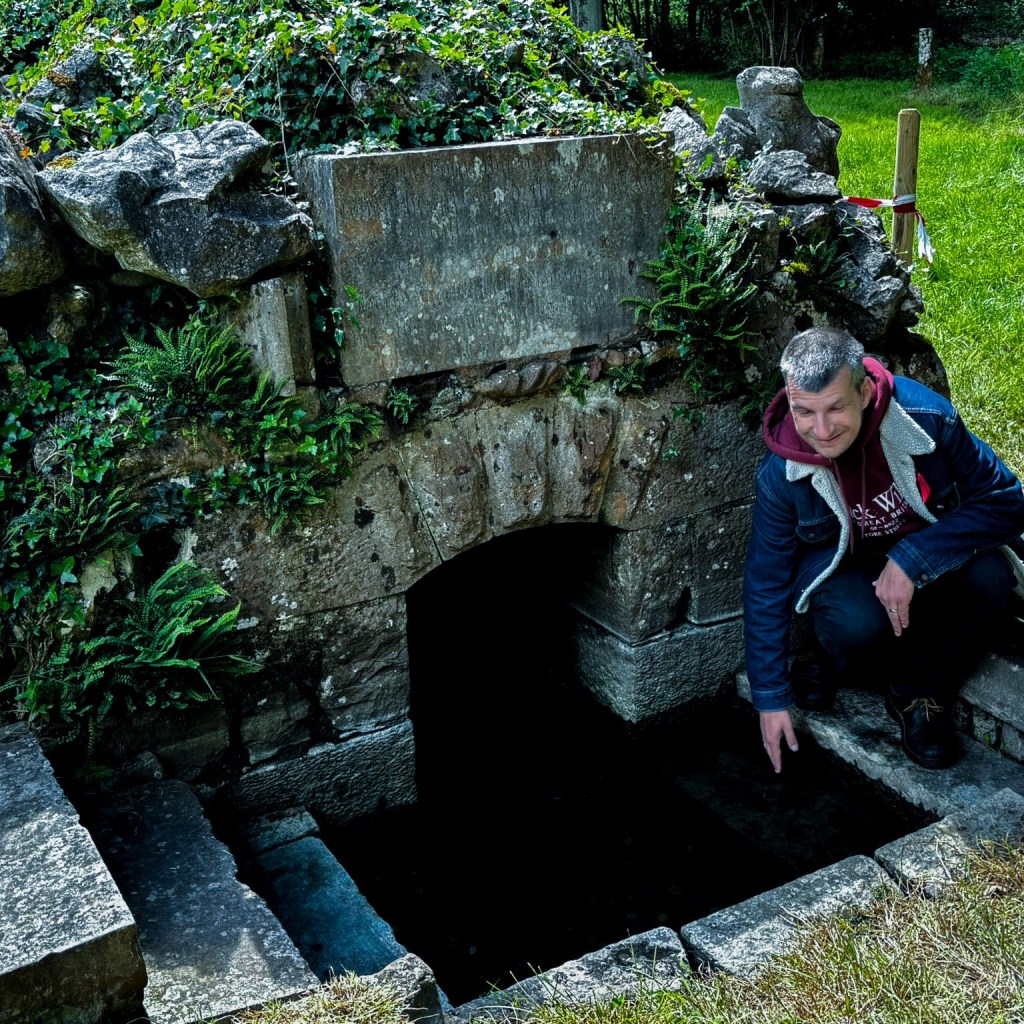
The body catching up with the soul.
St Columcille’s Well, Durrow, 9 June 2026.. Photo: Philip McKinley.
Modern Celtic spirituality often speaks of the Holy Spirit as the Wild Goose rather than the gentle dove of later devotional art. A goose is loud, intensely loyal, fiercely protective of its community, and operates on an internal navigational map hidden from the rest of the world.
To be wonderfully wired is often to feel like that wild goose: loud in a world that demands a quiet mask, navigating by an internal compass that others cannot see, and finding Christ not in vague abstractions, but in the hyper-specific, beautifully ordered patterns of wind, water, bread, and ancient memory spoken aloud in an old stone church.
The Wild and Holy Goose
The winds blow hard across the land
The river blue runs near
St Ciaran blessed this holy place
His bells rang loud and clear.

From age to age we come to pray
In this most blessed place.
From day to day God works in us
To run His holy race.

Columba came we know of old
A child in arms he blessed
The date of Easter he discussed
A synod he foretold.

May we, O God, like ancient saints
Your risen life tell forth;
And with the Wild and Holy Goose
Spread peace throughout the land.
Copyright
© Michael McFarland Campbell. 2026.
Permission granted for local church or parish use with attribution. Not for commercial reproduction.
Poem written on St Columba’s Day, 9 June 2026, following a Eucharist in Temple Connor, Clonmacnoise and a visit to St Columcille’s Well in Durrow, shared here as part of the NeuroDivine project.


 NeuroDivine
Leave a comment