Where earth and heaven brush as one
Where earth and heaven brush as one,
In dawn’s half‑hidden grace,
Your witness rises like the mist
That haunts each holy place.

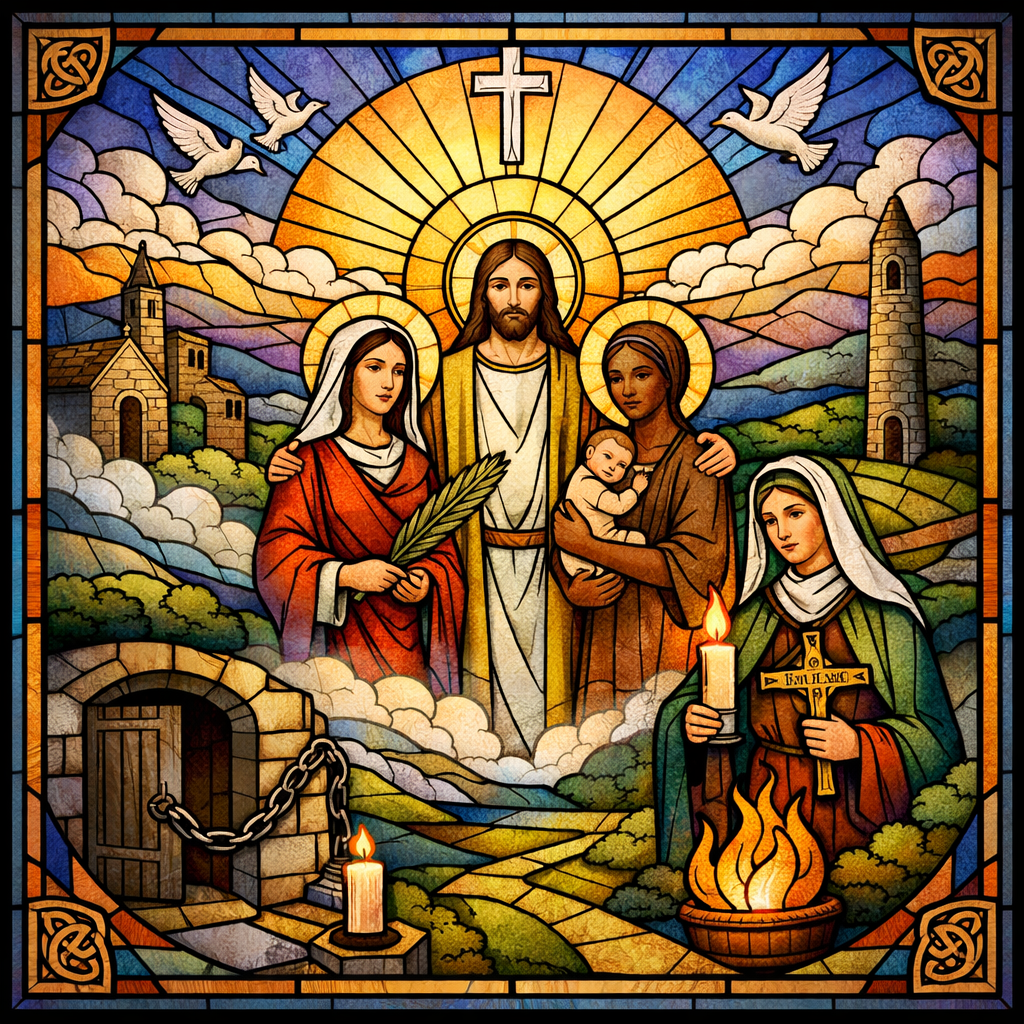
Perpetua, in prison’s dark,
A doorway opened wide;
You walked the threshold unafraid,
For Christ stood at your side.

And Felicity, in labour’s hour,
You felt the nearness too;
The veil grew thin, and strength was born
From love that carried you.

As Brigid’s flame on Kildare’s hill
Still warms the drifting air,
So burned your faith — a steady light
That banished fear and care.

Like larks that rise through morning haze
To realms our eyes can’t see,
You showed how souls in God’s deep peace
Find truth and liberty.

O Christ, who meets us on the edge
Where mortal pathways end,
Let thin‑place grace renew our hearts
Through these brave martyr‑friends.
Hymn information
First line: Where earth and heaven brush as one
Text: Michael McFarland Campbell
Metre: Common Metre
Theme: SS Perpetua and Felicity, Early Christan Martyrs
Reflection
Today’s the day the Church puts us in mind of Perpetua and Felicity. They were two women whose names have been whispered down through the generations, and sure, their story is one of those rare moments where you’d swear heaven and earth were leaning in to have a word with one another. We’d call it a “thin place”—one of those spots where the wall between this life and the Next is no thicker than a leaf.
A Voice from the Shadows
Now, Perpetua left us her diary, written right there in the dark of the prison. It’s a powerful thing entirely—one of the first times we hear a woman’s own voice in the story of the Church. You can see the dread in her, of course, but there’s a grander courage standing right beside it. She had this vision of a great ladder reaching up to the sky, and she spoke with a sort of quiet certainty about the hope that was pulling her toward the dawn, far beyond the noise of the arena.
The Quiet Strength of Felicity
And then there’s young Felicity. A girl in service, barely more than a child herself, giving birth in the cold of a cell just days before the end. You’d think she’d be broken by it, but she faced what was coming with a calmness that’d take the heart out of a giant. It put the fear of God in the ones watching her, so it did, to see such peace in a person so small.
The Landscape of the Spirit
When I sat to write the hymn, the old Celtic images started rising up in me like the tide. It’s the way my mind works—seeing the faith in the mists lifting off the fields or the lark rising up through the first light of the morning. I found myself thinking of St Brigid, too, and that steady flame she kept lit at Kildare—a warmth that never goes out, no matter how hard the wind blows.
In the verses, all those bits of life come together:
- The prison door becoming a wide-open gate.
- The pains of birth turning into the strength of the spirit.
- The heavy mist of the world clearing away in the morning sun.
A Companionable Faith
What stayed with me most was that their story isn’t about being a “hero” in the way the world talks about it. It’s just about trust. They didn’t walk into that arena on their own; they stepped out because they knew Christ was there, holding the door for them.
The prayer at the end of the hymn is just this: that the same “thin-place grace” that held them up might find its way to us, too. Especially when we’re feeling a bit fragile, or when life has us standing on the edge of something we can’t quite see into yet.
Copyright
© Michael McFarland Campbell. 2026.
Permission granted for local church or parish use with attribution. Not for commercial reproduction.


 NeuroDivine
Leave a comment