At evening, God has spoken
At evening, God has spoken
a word both strong and mild:
“Sit here at my right hand now,
my first‑born, holy child.”
Across the silent midlands,
where dusk and day entwine,
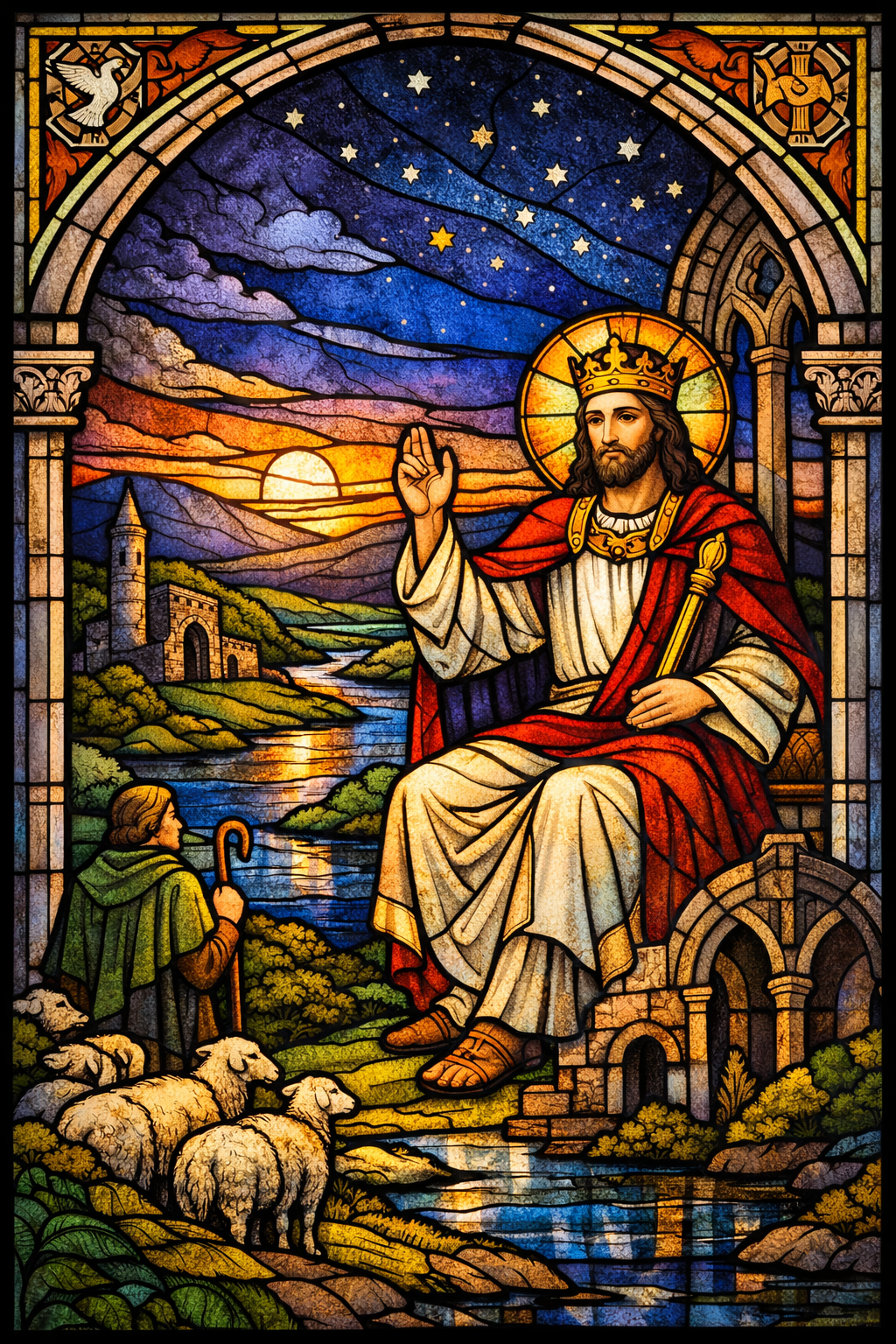
your reign, O Christ our High King,
shines out with light divine.

From heather‑shadowed hilltops
your gentle rule extends;
the Barrow bears your blessing,
the valleys call you friend.
Your people come before you
like dew in circling grace,
renewed in holy stillness
within this thin‑place space.

A priest forever standing
where earth and heaven meet,
you gather all our labour
and lay it at God’s feet.
In moss‑clad ancient arches,
in fields where saints once trod,
your cloak of peace surrounds us,
and draws us close to God.

Though nations rage in daylight
and storms of worry rise,
your truth at dusk enfolds us
like stars in deepening skies.
So keep us through the night hours,
our shepherd, strong and near,
till dawn reveals your glory
and scatters every fear.

All glory to the Father,
whose light the hills proclaim;
to Christ, our elder brother,
High King of gentle flame;
and to the Holy Spirit,
whose whisper stirs the air:
we dwell within your shelter,
held fast in nightly prayer.
Hymn information
First line:
Text: Michael McFarland Campbell
Metre: 76 76 D.
Suggested Tune: Salley Gardens 76 76 D.
Theme: Evening hymn, based on Psalm 110
Reflection
There are few psalms that come back over and over in the still rhythm of the Church’s evening prayer like friends we know well. One of these is Psalm 110, one of the perennial psalms designated for Sunday Vespers. Its opening lines —
“The Lord said to my Lord:
Sit at my right hand”
— have reverberated across centuries of prayer in Christ’s church, directing us toward the king and priest to Christ himself.
That ancient psalm and its place in the Church’s evening worship are the source of this hymn, At Evening, God Has Spoken. Vespers has long been an occasion for the Church to contemplate Christ’s rule not in the din of midday, but in the whisper of twilight. Psalm 110 proclaims the exaltation of Christ, but in the calm of evening it can also be heard as a promise of quiet sovereignty: The One who reigns is also the One who gathers the labour and cares of the day and places them before God.
The imagery of the hymn situates that ancient psalm within the landscapes of Ireland’s midlands — heathered hills, the slow waters of the Barrow and the sacred stillness frequently depicted in Celtic spirituality as a “thin place,” where heaven and earth appears especially close by. Into these places the words of Psalm 110 seem to sit in a meditative pose: Christ the High King who reigns lightly to the earthward, and Christ the priest of eternal ages who makes an appearance where earth and heaven meet.
Even as the psalm speaks of conflict among nations, the hymn shifts outward to the peace of evening prayer. As the worries of day wear away and the sky turns into stars the Church once again puts itself in the shepherding presence of Christ — waiting through the night until the day comes when God is to be seen. More directly, the hymn is an echo of what Sunday Vespers has always been: a time when the Church stops at the end of the day, remembers who rules and then lays in rest the quiet assurance that both the world –and one’s weary heart – is in the care of Christ.
Copyright
© Michael McFarland Campbell. 2026.
Permission granted for local church or parish use with attribution. Not for commercial reproduction.


 NeuroDivine
Leave a comment