Long have burdens pressed upon us
Long have burdens pressed upon us,
deep the furrows carved in pain;
yet the Lord of oak and river
keeps our hope from breaking vain.
Like the rush that bends in tempest,
like the stone that stands the tide,
so your people, God of mercy,
rise again, though scarred, yet tried.

Hands have struck and hearts have wounded,
paths grew narrow, steep, and long;
still your covenant surrounds us
like a woven ancient song.
Braided grace in Celtic pattern,
threads of gold through grief and night,
binds our stories to your promise,
turns our darkness into light.

Let the schemes of those who harm us
wither like the barren clay;
let their roots find only dryness,
let their shadows flee away.
But your blessing, God of justice,
flows like Barrow’s quiet stream,
washing clean the fields of sorrow,
planting peace where once was dream.

So we walk the pilgrim’s roadway,
trusting love to lead us on;
Christ beside us, Christ before us,
Christ our dusk and Christ our dawn.
From the furrows of our history,
from the wounds we cannot hide,
you, O God, lift up your people—
ever faithful at our side.
Hymn information
First line: Long have burdens pressed upon us
Text: Michael McFarland Campbell
Metre: 87 87 D
Tune: Manor House
Theme: Psalm 129
Reflection
Some psalms do not pretend that life has been easy. Psalm 129 begins with a stark admission:
“Greatly have they oppressed me from my youth.”
Yet the psalm is not a song of defeat. It is a declaration that, despite the scars of history and the wounds carried by communities and individuals, God’s faithfulness endures.
This hymn grew out of that psalm. I wanted to echo its honesty about suffering while placing it within an Irish landscape—oak, river, rush, and stone—images that speak of resilience in this place. The psalmist speaks of furrows cut deep by those who harmed them; in the hymn those furrows remain, but they also become the soil from which hope can rise again.
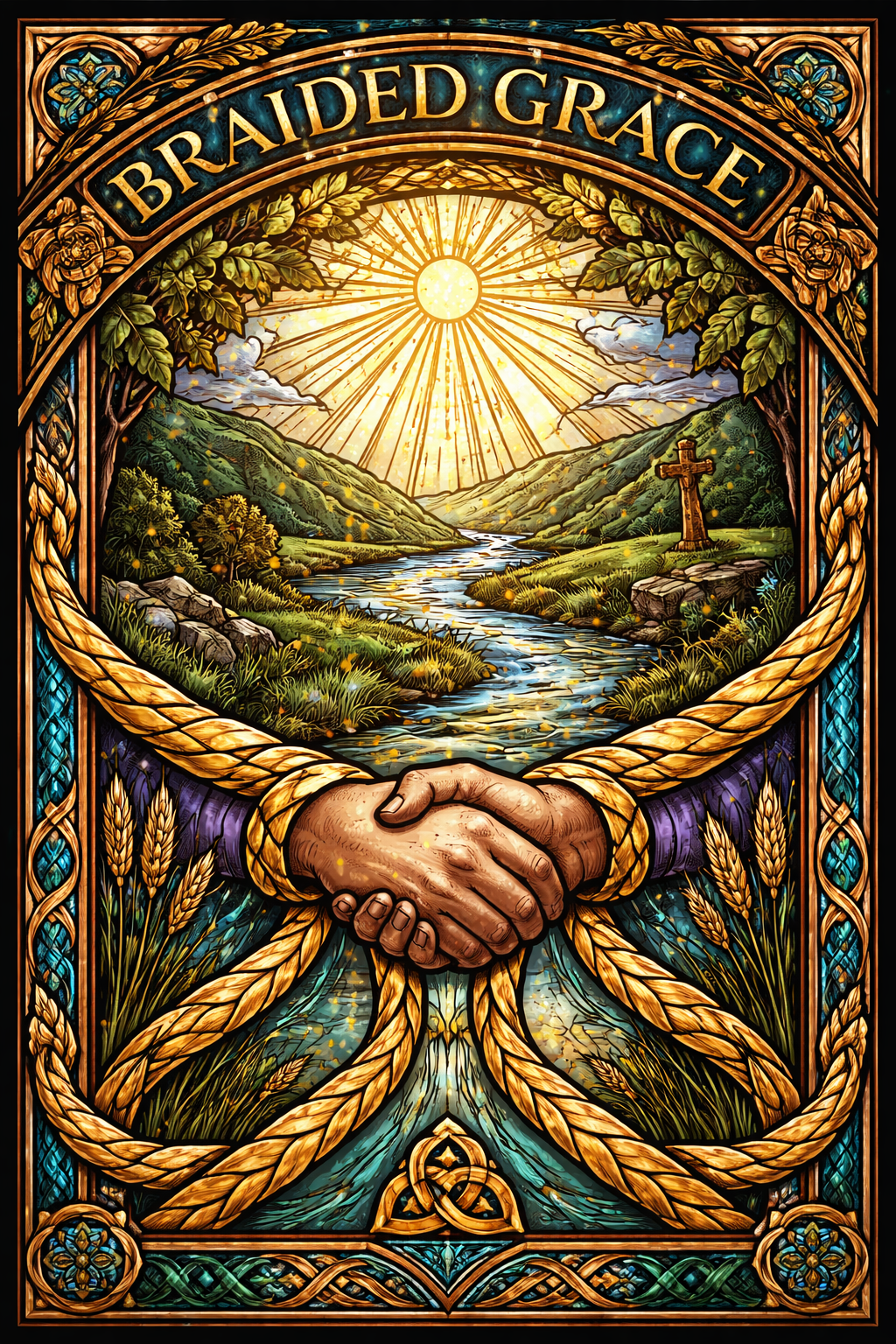
One image that emerged while writing was the idea of weaving. In Psalm 129 the “cords of the wicked” are cut—the ropes that bind and oppress are broken. In the hymn I tried to let that image turn gently: the cords of captivity are replaced by braided grace, a covenant woven like a Celtic pattern, threads of gold running through grief and night. What once bound in pain becomes, in God’s mercy, the pattern that holds us in promise.
For me, Psalm 129 is not about revenge but about trust: the quiet conviction that injustice does not have the final word. God’s covenant continues to bind our stories together—not with cords of oppression, but with grace.
The final verse turns toward pilgrimage. We continue walking, not because the road has been easy, but because Christ walks with us—before us, beside us, and through every dusk and dawn.
Even scarred, God’s people rise.
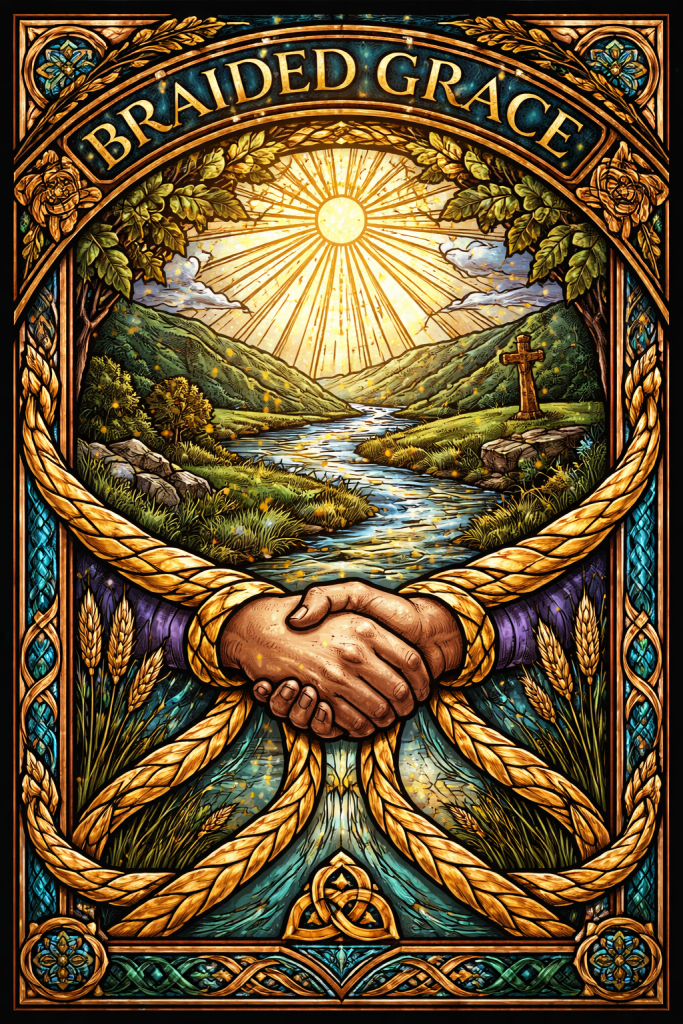
Stained-glass style artwork titled “Braided Grace.” In the centre, two scarred hands clasp in solidarity, wrapped with shining golden braided cords that symbolise covenant rather than bondage. Above them, a bright sun radiates over an Irish landscape of green hills and a winding river, with a Celtic cross standing beside the water. Oak leaves, wheat, and Celtic knotwork frame the scene, suggesting resilience, harvest, and enduring promise. The glowing glass colours evoke themes of healing, faithfulness, and hope rising from suffering, inspired by Psalm 129.
Copyright
© Michael McFarland Campbell. 2026.
Permission granted for local church or parish use with attribution. Not for commercial reproduction.
See also
Readers may be interested in my ongoing work A Pilgrim’s Psalter of Earth and Light, where this hymn will be published.


 NeuroDivine
Leave a comment