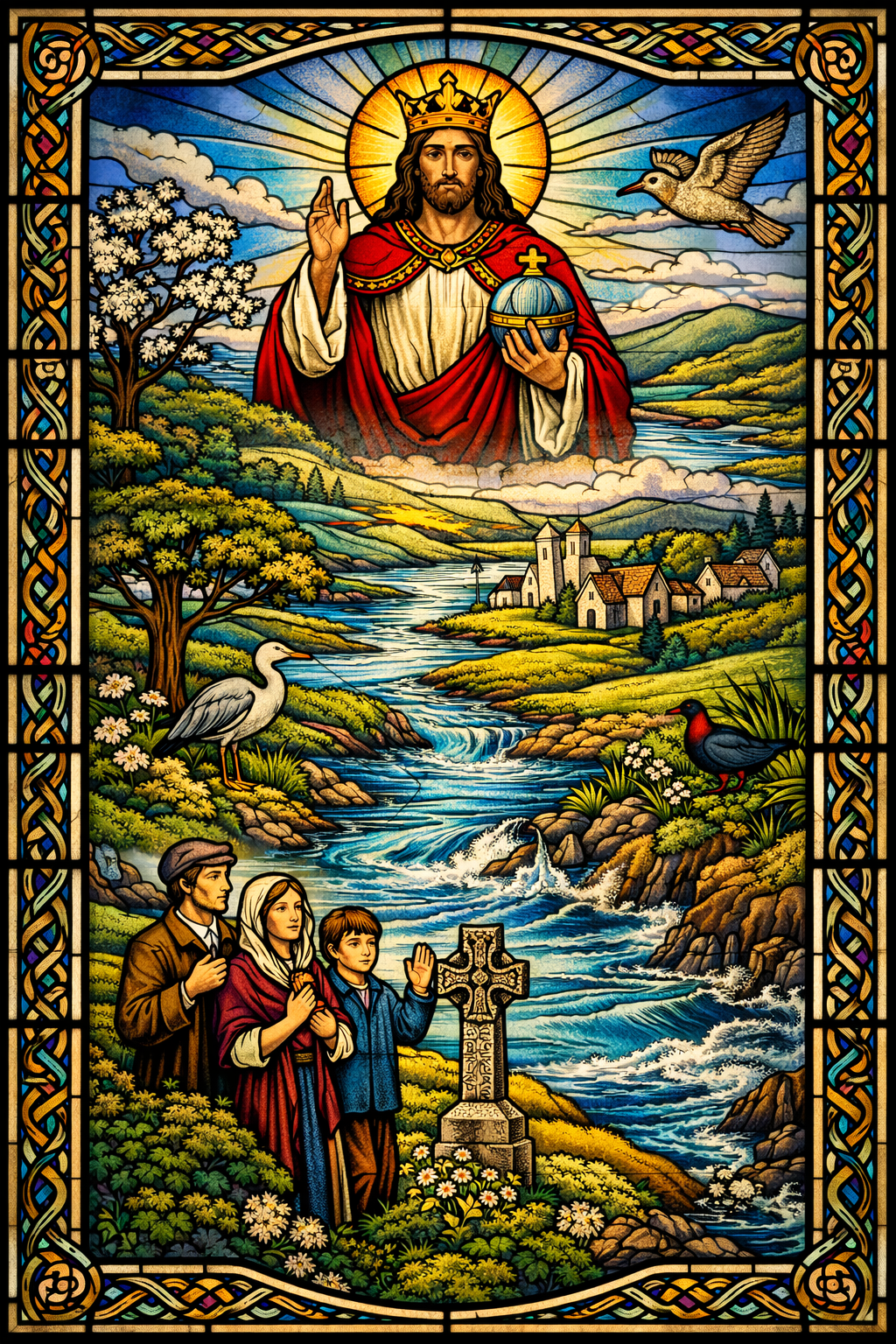
“Sing to the Lord a new song…”
Psalm 98 is not shy. It is tidal. It calls rivers to clap their hands and hills to sing for joy. It insists that creation itself is caught up in praise—not as backdrop, but as choir.
In the Anglican tradition, Psalm 98 can be used at Evensong as an alternative to the Magnificat. That has always fascinated me. The Magnificat is intensely personal—“My soul magnifies the Lord.” Psalm 98, by contrast, is gloriously expansive. It widens the lens. Instead of Mary’s voice, we hear the sea roaring, the floods applauding, the hills breaking into song.
When I sat down to write this hymn, I didn’t want simply to paraphrase the Psalm. I wanted to let it walk through Ireland.
So the blackthorn bloomed along the lanes.
The curlew wheeled over wet fields.
Rivers ran with something like applause.
Psalm 98 speaks of justice—not abstract, but embodied. A righteousness that fills the earth. For me, that meant parish stones and narrow lanes, quiet seas and windswept shores. It meant imagining praise not as performance, but as landscape. Meadowsweet bending in the breeze. Oak and ash standing in steady joy. Even the heron waiting—patient, attentive—as if stillness itself were worship.
There is something deeply grounding in Psalm 98’s insistence that praise is not noise alone. It is pattern. It is tide. It is season. It is repetition that does not exhaust itself.
“Sing a new song,” the Psalm says—but the song is as old as rivers.
At Evensong, whether we sing Mary’s fierce joy or the roaring praise of creation, the truth is the same: God’s justice is coming, and the whole earth is invited to rejoice.
Writing this hymn felt less like composing and more like listening. Listening to Scripture. Listening to the land. Listening for where righteousness and mercy meet the particular soil beneath my own feet.
The rivers are already clapping.
Sing a new song to our High King
Sing a new song to our High King,
whose mercy floods the land;
whose justice rises, firm and sure,
like tides along the sand.
The blackthorn blooms along the lanes,
the curlew wheels in flight;
all Ireland lifts its breath in praise
before the Lord of light.

The meadowsweet in summer fields
moves softly in the breeze;
the oak and ash stand tall with joy
beside the quiet seas .
The heron waits in patient grace,
the moorhen skims the reeds;
all join the song creation sings—
the Lord has done great deeds.

Let rivers clap their running hands,
let hills in gladness rise;
let every parish stone and lane
proclaim Him to the skies.
For truth shall guide the wandering heart,
and peace shall crown the meek;
God’s righteousness shall fill the earth—
the justice that we seek.

So lift your voice, O people here,
in every place you stand;
from quiet fields to windswept shores
across this singing land.
The Holy One has made us whole,
our hope is born anew;
sing praise with all the living earth—
God’s love is ever true.
Words copyright 2026 Michael McFarland Campbell. All rights reserved.

Alt-text:
A stained-glass window in rich blues, greens, and golds shows Christ crowned as High King at the centre, raising his hand in blessing and holding a blue orb. Behind him, the Irish countryside stretches with rolling hills, a winding river, and a small village church. A blossoming blackthorn tree frames one side, while a curlew flies across the sky. Below, a heron stands by the riverbank and a moorhen rests among reeds. In the foreground, an Irish family stands beside a carved Celtic cross, looking upward in prayer. The whole scene is bordered with intricate Celtic knotwork, blending faith, landscape, and praise into one unified composition.


 NeuroDivine
Leave a comment