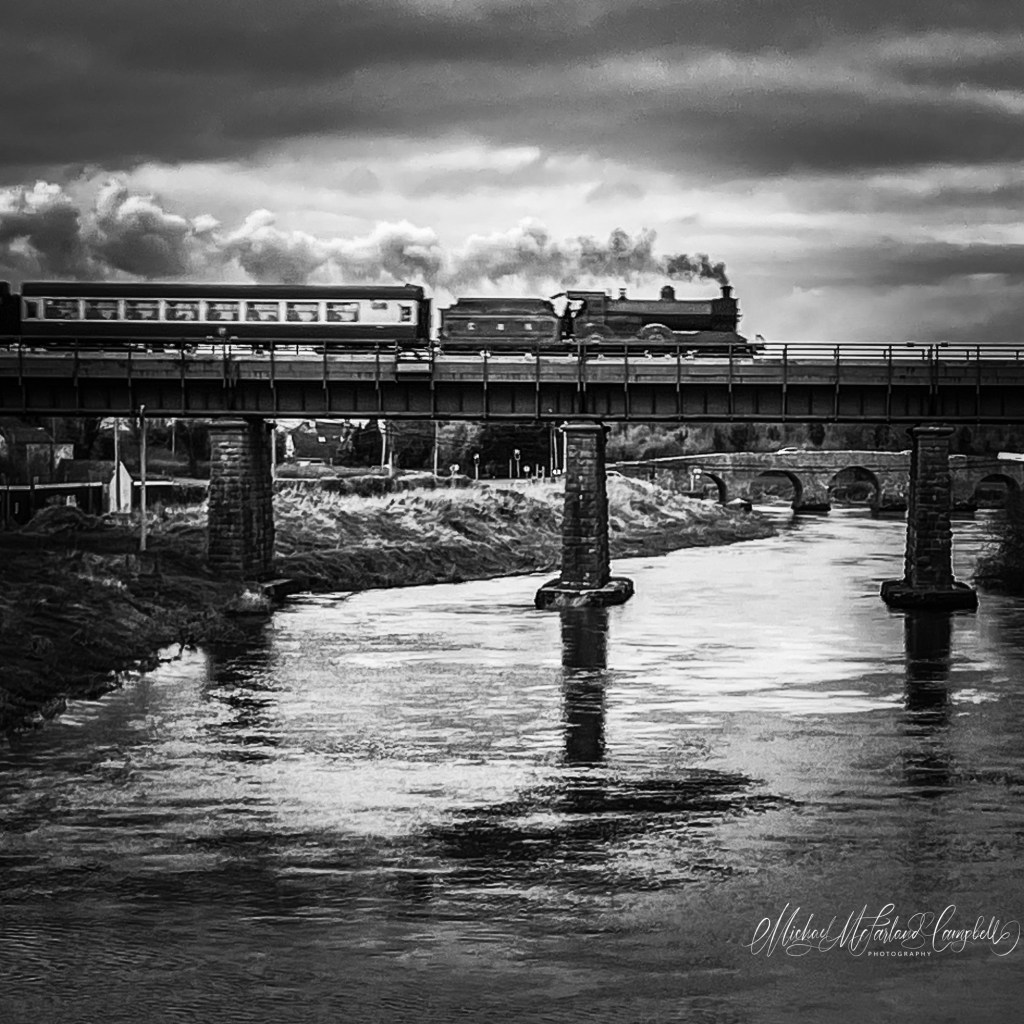
This evening I found myself standing between layers of movement.
The river flowing dark and slow. The canal holding the last of the light. And high above, the long stone ribs of the Barrow Viaduct carrying a train across the fading sky.
Across the Barrow Viaduct grew out of that layered stillness.
The engine in the poem is not imagined. She is GSWR 171 Slieve Gullion—real, preserved, weighty with history. Naming her matters.
She is not a metaphor first.
She is steel, fire, engineering, craft.
A survivor of another age of movement.
And yet when 171 Slieve Gullion climbs the span at dusk, breathing steam into cooling air, something happens. The past does not feel distant. It feels present. Audible. Rhythmic. Measured.
There is something deeply Benedictine about that.
The locomotive moves—but within rails.
The river moves—within its banks.
The canal rests—within its cut stone.
The viaduct bears weight—without strain.
Structure is not confinement. It is stability.
For many neurodivergent people, form is what allows freedom. Common Metre itself—86.86—is a kind of rail line. It carries the poem forward steadily. Predictably. Safely. Within that form, feeling can move without chaos.
The poem rests in layers:
• water beneath
• iron above
• light fading
• lamps waking
• two figures watching
No spectacle. Just attention.
Dusk can be a vulnerable threshold hour—sensory shifts, changing light, the subtle unease of transition. But on the aqueduct, watching 171 Slieve Gullion cross the viaduct, the movement felt ordered rather than abrupt. The world was changing, but not collapsing.
Stone piers still “guard the crossing place.”
The engine carries memory forward.
The canal holds the present.
The river keeps moving regardless.
Neurodivine faith often lives there—not in noise, but in noticing.
Sometimes holiness is simply standing by the rail as the lamps come on, allowing the day to close, naming what is real, and letting continuity carry you into night.
Tonight, that felt enough.
Across the Barrow Viaduct
The river bears the evening light,
Its currents dark and slow;
Above, the engine threads the height
Where only wild winds go.

Old Slieve Gullion shakes the air,
Her heartbeat forged in steam;
She climbs the span with iron flair,
A memory and a dream.

We watch her from the aqueduct,
Where water hums below;
The viaduct’s long ribs conduct
Her steady, rhythmic flow.

The canal holds the fading day,
Its waters still and wide;
A heron lifts in quiet grey
Along the shadowed side.

The first lamps wake along the tow,
Their glimmers soft and small;
They stitch a quiet, golden row
Beside the dark canal.

Two figures linger by the rail,
The dusk around them drawn;
They watch the last of daylight pale
And feel the night come on.

Stone piers still guard the crossing place
And hold her iron line;
The past moves through her smoke‑soft trace,
The present in her shine.
Words copyright 2026 Michael McFarland Campbell.


 NeuroDivine
Leave a comment