This hymn didn’t emerge in a chapel.
It came overnight.
In silence.
In storm.
In the unbuilt monastery of the mind.
“Wild winds rise fierce across the plain,
My refuge be.”
The imagery came quickly. But the deeper formation came slowly—as most Benedictine things do.
I’m part of a Benedictine community without walls.
We are dispersed across Ireland—lay and ordained, married and single, straight and gay.
No cloister. No stone.
But a shared call to remain.
That, too, is stabilitas.
Staying not in one location, but in one rhythm.
Not in uniformity, but in covenant.
Not in silence enforced by walls, but in silence chosen, over and over, in the middle of our varied lives.
When I wrote the refrain—
“You are my stay.”—
I heard it differently.
It was not just a cry for help.
It was a vow.
You are my stay when my body feels unstable.
You are my stay through the quiet hours when others sleep.
You are my stay when the rule feels invisible but no less real.
The Rule of St Benedict begins in the dark.
Literally—with vigils, the Night Office.
Prayer before the dawn.
And for many of us—neurodivergent, chronic illness, those navigating uncertain futures—the spiritual path starts overnight. In the unspeakable places. In the storms.
This hymn moves:
Storm → Lark-song → River path.
But dawn only comes after the decision to stay through the night.
That’s what our community does.
That’s what Benedict asked.
That’s what my body has learned through endurance.
Your justice keeps me on the path,
Again, again.
This is my monastery now:
• A body that bears witness.
• A rhythm of prayer shared with others I rarely meet in person.
• A staying that does not rely on walls but on a vow repeated in storms and silence alike.
NeuroDivine is where all of this meets:
Benedictine rhythm.
Neurodivergent reality.
A dispersed body held in shared staying.
Storm.
Stay.
Vigil.
Dawn.
Path.
Again, again.

“An open book of printed sheet music sits beside a lined notebook page filled with handwritten lyrics in blue ink. The hymn title at the top of the music page reads ‘God the Holy Trinity, Three-in-One,’ with staff lines and musical notation below. On the right, neatly written cursive lyrics begin with ‘O God, attend my cry, Lord, draw near to me,’ and continue in several stanzas. The book’s spine runs vertically down the center of the image, dividing the printed music on the left from the handwritten text on the right.”
Hymn: Psalm 54
O God, attend my cry,
O Lord, draw near to me;
Wild winds rise fierce across the plain,
My refuge be.
The proud rise up in might,
Their hearts are cold and blind;
They do not walk your holy ways,
your strength to find.

Your mercy is my stay,
You guide me day by day;
As lark‑song stirs the early fields,
You are my stay.
You hold my trembling heart,
You calm my deepest fear;
Your light spreads wide on heathered hills,
And you are near.

With thankful voice I sing,
I praise your holy name;
For you have held me through the night,
My song I frame.
Through river‑rush and reed,
Through quiet glen I go;
Your justice keeps me on the path,
Again, again.
Words copyright 2026 Michael McFarland Campbell.
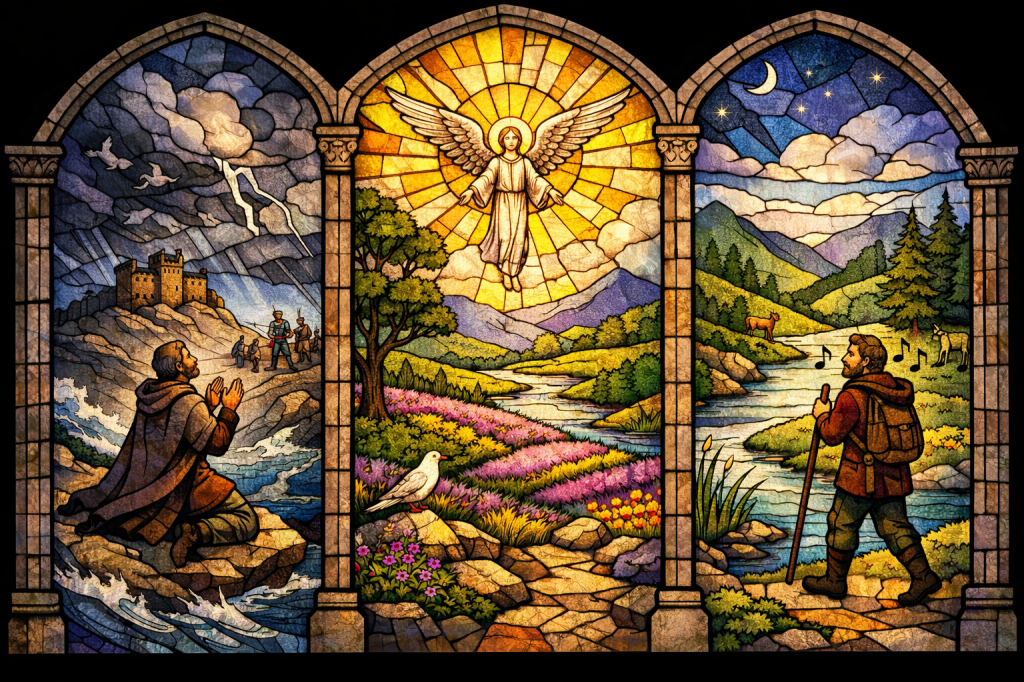
Alt text:
Triptych stained-glass window with three arched panels. In the left panel, a robed man kneels on rocks beside rushing water under dark storm clouds, praying as lightning splits the sky and armed figures stand in the distance. In the centre panel, a radiant angel with outstretched wings hovers above a peaceful river valley filled with flowers, trees, and golden sunlight streaming outward in bright glass rays. In the right panel, a traveler with a walking staff and pack stands beside a calm river under a crescent moon and stars, with mountains, trees, and deer nearby. The colours shift from stormy blues and greys on the left to warm gold in the center and tranquil blues and greens on the right, symbolizing distress, divine presence, and peaceful guidance.


 NeuroDivine
Leave a comment