Unknown Paths, Rising Hills: Writing a Hymn for the Second Sunday in Lent (Year A)
The readings for the Second Sunday in Lent (Year A) always feel like they are about movement—not certainty, not arrival, but movement.
In Genesis 12:1–4a, Abram is called to leave what is known and step toward a promise he cannot yet see.
Psalm 121 lifts our eyes to the hills—not as escape, but as a reminder that help comes from beyond our limited field of vision.
In Romans 4, Paul dismantles spiritual striving and replaces it with gift—righteousness not earned but received.
And in John 3:1–17, Nicodemus comes at night, bewildered, trying to understand new birth.
When I sat down to write this hymn, I found myself thinking not only about Abram’s journey, but about the kind of journey Lent is—and, perhaps, the kind of journey neurodivergent faith often is.
Called Out to the Unknown
“You call us out to unknown paths, Like Abram long ago…”
Abram’s call is destabilising. There is no map. No timeline. No clear outcome. Just a promise and a direction: Go.
For many of us—especially those whose brains don’t process certainty, change, or ambiguity in neat, linear ways—“unknown paths” are not romantic. They are overwhelming.
But the text doesn’t say Abram understood. It says he went.
That distinction matters.
Faith, in this reading, isn’t clarity. It’s consent to movement.
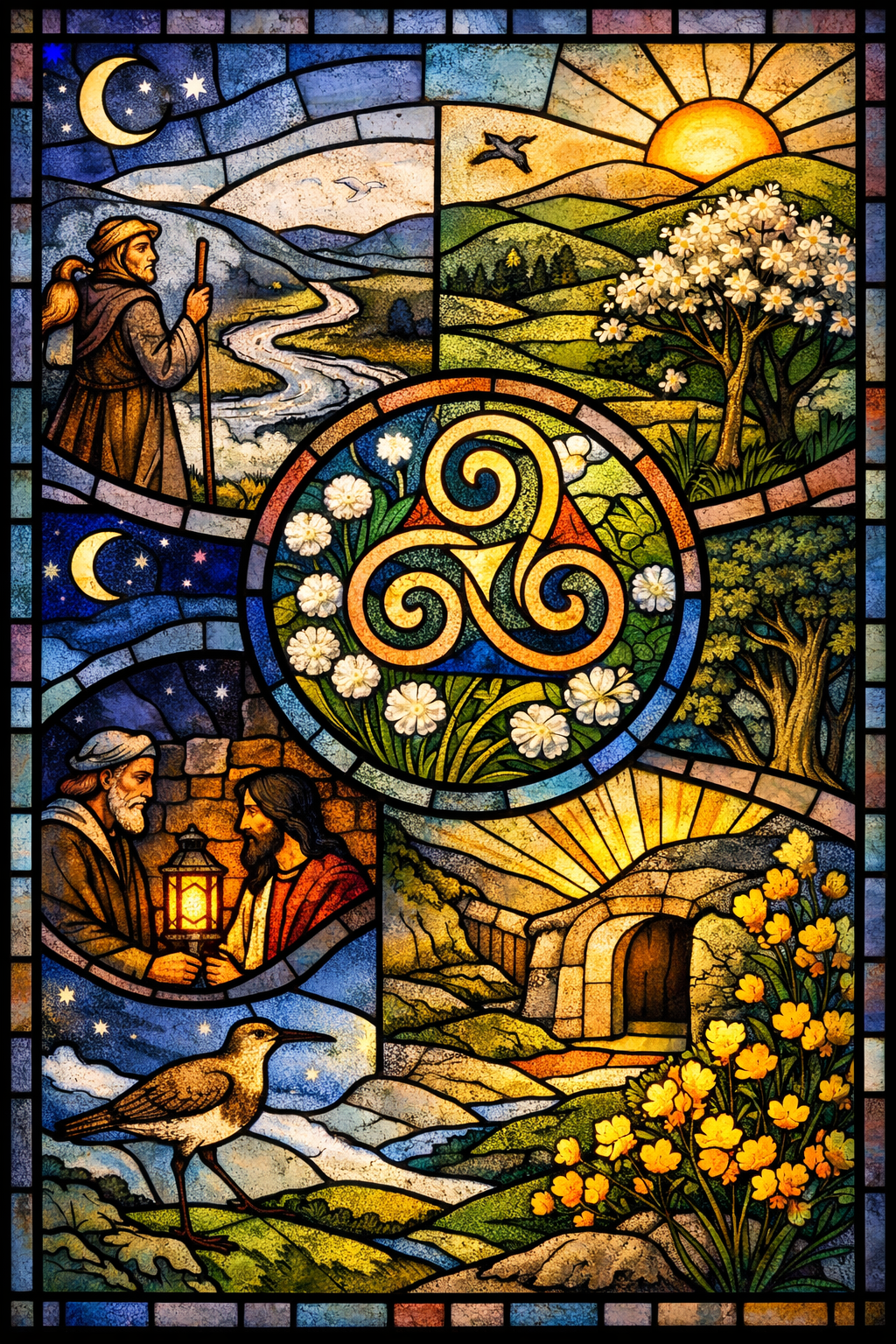
I located that movement along “the Barrow’s bends”—placing Abram’s journey into an Irish landscape of mist and ancient earthworks. The story may be ancient Near Eastern, but the call to step into the unfamiliar belongs to every land and every nervous system.
Lifting Our Eyes
Psalm 121 feels sensory to me.
“You lift our eyes to rising hills, Where skylarks greet the dawn…”
This is not theology in abstraction. It is embodied reassurance:
shade in heat, guarding through night, presence in vulnerability.
For neurodivergent people especially, safety is not theoretical. It is physical. Regulated. Felt.
The “keeping shade, like hawthorn’s bough” is not a metaphor for domination but for gentleness—protective without suffocating. A God who guards without overwhelming the senses.
Psalm 121 insists: help comes from beyond us, but it is not far from us.
Not by Striving
Romans 4 interrupts performance religion.
“Not by our striving, strength, or claim But gift of grace alone…”
Paul is radical here. Belonging is not achieved through spiritual productivity.
For those of us who have internalised the message that we must work harder—socially, spiritually, cognitively—this is disruptive good news.
Grace does not require masking.
Faith is not flawless execution.
Belonging is not earned by managing to appear “normal.”
Abram believed—and that was counted as righteousness.
That’s it.
Night-Time Questions
“At night, like Nicodemus came, We seek the truth you bear…”
Nicodemus is one of the most neurodivergent-feeling figures in the Gospels to me. He is thoughtful, literal, slightly bewildered, brave enough to ask but careful about exposure.
He comes at night—perhaps out of fear, perhaps out of contemplation. Jesus does not shame him for misunderstanding. Instead, he invites him into mystery:
“The wind blows where it chooses…”
Or as the hymn says:
“Your Spirit moves like curlew’s cry Across the open air.”
The Spirit is not controlled. Not systematised. Not reduced to tidy doctrine. It is heard before it is grasped.
For those of us who experience faith not as straight-line logic but as pattern, movement, sound, and symbol—this matters.
New Birth in the Landscape
“New birth you breathe through bog-cotton, Through ash and ancient yew…”
John’s Gospel speaks of being “born from above —or “born again.” It’s a phrase that has often been flattened into a single kind of conversion narrative.
But what if new birth is organic? Cyclical? Layered?
The image of the triskele—three spirals turning from a shared centre—became my quiet Trinitarian symbol in this hymn. Not rigid geometry, but motion. Interwoven life. Breath within breath.
New birth is not a personality transplant.
It is the Spirit meeting us in the soil we already inhabit.
Lent as Starlight
The final verse holds us in Lenten time:
“So lead us on through Lenten days, By starlight’s quiet gleam…”
Lent is not yet Easter. It is not blazing sunlight. It is often starlight—enough to move by, not enough to see the whole road.
But starlight is faithful.
And Easter?
“Till Easter breaks like gorse in bloom…”
In Ireland, gorse doesn’t arrive politely. It erupts—shockingly yellow against grey hills. Resurrection feels like that: sudden brightness after long restraint.
You call us out to unknown paths,
Like Abram long ago;
Through mist along the Barrow’s bends,
Your pilgrim people go.

You lift our eyes to rising hills,
Where skylarks greet the dawn;
Your keeping shade, like hawthorn’s bough,
Stands guard till night is gone.

Not by our striving, strength, or claim
But gift of grace alone,
You shape a people born of faith,
As seeds the wind has sown.

At night, like Nicodemus came,
We seek the truth you bear;
Your Spirit moves like curlew’s cry
Across the open air.

New birth through bog‑cotton you breathe,
Through ash and ancient yew;
The triskele’s turning speaks of life
Made whole in breath from you.

So lead us on through Lenten days,
By starlight’s quiet gleam;
Till Easter breaks like gorse in bloom
And hope restores our dream.
Michael McFarland Campbell is a neurodivergent liturgical writer, organist, and storyteller living with chronic illness and fierce compassion. Rooted in Benedictine spirituality, his work transforms everyday routines—dialysis, knitting, walking, pain management—into sacred reflections. Through humour, advocacy, and creative care, he uplifts the dignity of the misunderstood and inspires inclusive acts of hope, connection, and healing.


 NeuroDivine
Leave a comment