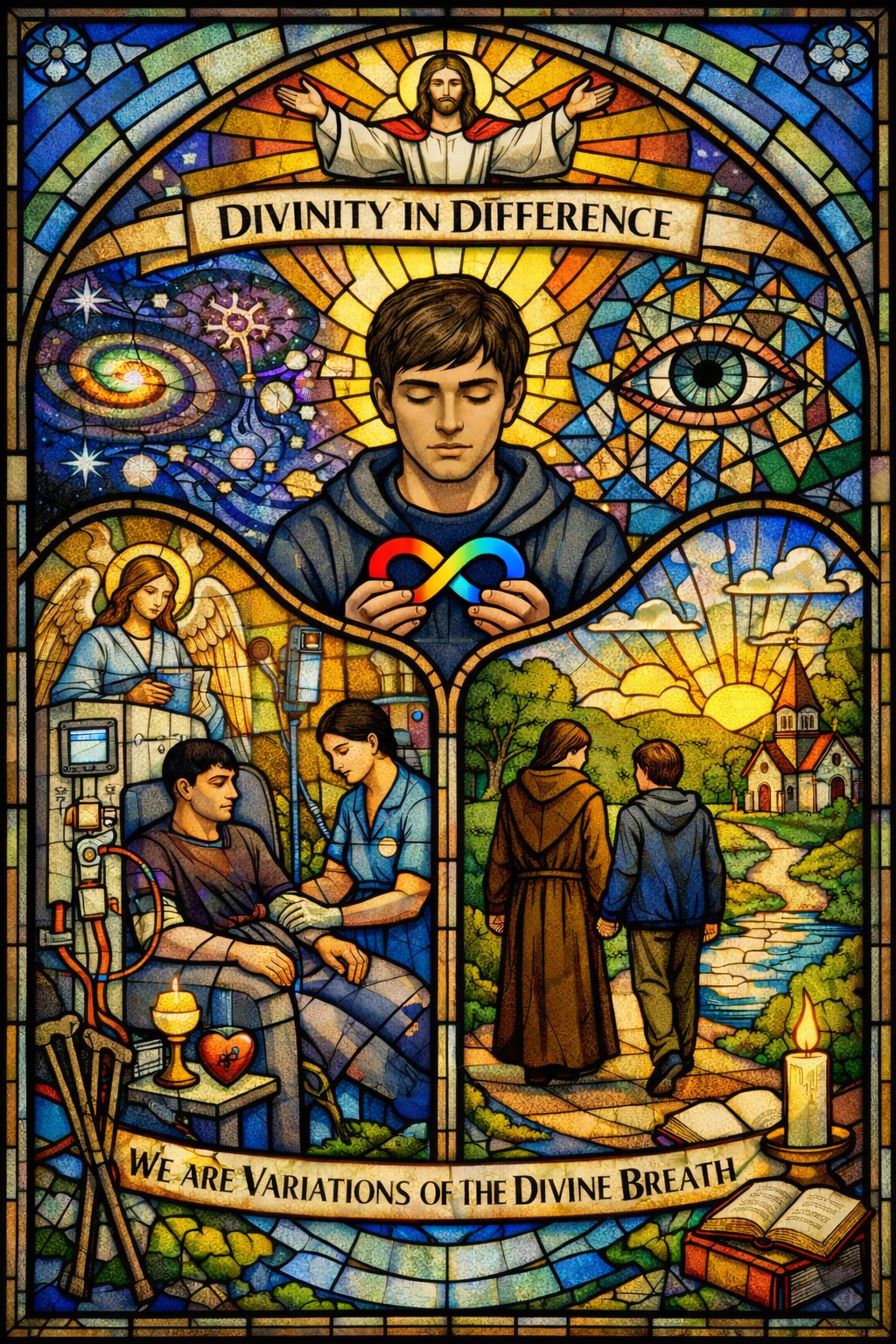
Every now and then, an image comes along that says in colour and light what pages of writing have been circling for years.
This stained-glass window feels like that.
It gathers the heart of NeuroDivine—the essays, the fiction, the hymns, the poetry—and holds them up to the light with one steady claim:
Difference is not a flaw in the image of God.
It’s how the image shines.
Not only neurological difference.
Not only the body that falters or needs support.
But also queer love.
Also gender variance.
Also the lives that were once told they didn’t fit inside the church walls.
Not outside faith.
Within it.
The Image of God—Not As Expected
At the centre of the window stands a young person holding a rainbow infinity symbol, the sign of neurodiversity. Around them, galaxies wheel and patterned light spills outward.
The rainbow is doing more than one thing.
It speaks of autistic and neurodivergent lives—minds that move in deep focus, in pattern, in intensity. But it also quietly signals LGBTQ+ belonging. It says that the spectrum of human love and identity is not a disruption of creation, but part of its breadth.
For too long, theology narrowed the image of God to something tidy—rational, controlled, straight, socially fluent.
In the essays, we question that narrowing. We ask whether the God who made stars and shorelines was ever interested in sameness.
In the fiction, we give you characters who are autistic, chronically ill, queer—and not waiting to be fixed. We let them pray. We let them desire. We let them doubt. We let them endure.
In the poetry, we allow language to bend and breathe, because sometimes a stanza can hold what a sermon cannot.
In the hymns, we try to sing what hasn’t always been sung in Irish churches—that queer bodies, autistic minds, and fragile hearts are not pastoral problems. They are bearers of grace.
The figure in the window doesn’t hide the infinity symbol. They hold it gently, as something sacred.
That small gesture says more than argument ever could.
The Liturgy of the Vulnerable
In the lower panel, a dialysis patient sits beside the machine. A nurse leans in carefully. There’s an angel reading nearby, and a candle burning steady.
It would be easy to paint that as tragedy.
Instead, the window paints it as liturgy.
In the essays, we speak of the “Liturgy of the Body”—the idea that the hospital can be a thin place. That the rhythm of treatment can become a form of prayer. That God may be found not only in cure, but in the quiet courage of returning again and again.
In the fiction, we sit in the chair with the character. We feel the tiredness. The repetition. The strange intimacy between patient and nurse. The holiness hidden inside ordinary medical care.
In the poetry, we name the scar without flinching.
In the hymns, we sing of a Christ who knows what it is to have a wounded body.
For LGBTQ+ readers, especially those told their bodies were wrong or disordered, this matters deeply.
The vulnerable body is not a theological inconvenience.
It is sacred ground.
The body that needs dialysis.
The body that loves differently.
The body that transitions.
The body that trembles.
None of these are outside the sanctuary.
Staying Put—As Holy Work
In another panel, a monk walks beside a young person along a river path, a small church waiting in the distance.
There’s something very Irish in that image—the long walk, the steady companion, the sense that holiness is found in the ordinary turn of the road.
Stabilitas, the Benedictine vow of staying, speaks to neurodivergent life in a particular way. Routine isn’t dullness; it’s steadiness. The same walk, the same prayer, the same cup of tea at the same hour—these aren’t limitations. They’re anchors.
In the essays, we explore how autistic rhythm can be a form of spiritual discipline.
In the fiction, we tell stories of those who refuse to abandon either themselves or their faith.
In the hymns, we sing of staying—not out of fear, but out of belonging.
In the poetry, we return again and again to rivers, to breath, to light through glass.
And for LGBTQ+ believers, staying can be its own act of courage.
Staying in the Church.
Staying in your body.
Staying in your name.
Staying in your love.
Not because it’s always easy.
But because you know, deep down, that you were never a mistake.
Christ With Arms Open
At the top of the window, Christ stands with arms outstretched.
Not measuring.
Not excluding.
Not drawing lines in the sand.
Open.
The light falls over all of it:
The autistic contemplative. The dialysis patient. The queer believer. The monk and the wanderer. The essays that wrestle. The fiction that imagines. The hymns that dare to sing. The poetry that breathes between the lines.
“Divinity in Difference,”
the window says.
And at the base:
“We Are Variations of the Divine Breath.”
That isn’t just a phrase. It’s the ground we’re standing on.
NeuroDivine exists because too many of us were taught to see ourselves as theological problems.
Through essays, we rethink what we were handed.
Through fiction, we show what could be.
Through hymns, we reclaim worship.
Through poetry, we remember how to breathe.
All of it rooted in neurodivergent experience.
All of it attentive to chronic illness.
All of it openly, unapologetically inclusive of LGBTQ+ lives.
Not as an add-on.
Not as a compromise.
But as stained glass.
And when the light comes through—
through difference, through fragility, through love that refuses to hide—
it doesn’t shatter.
It glows
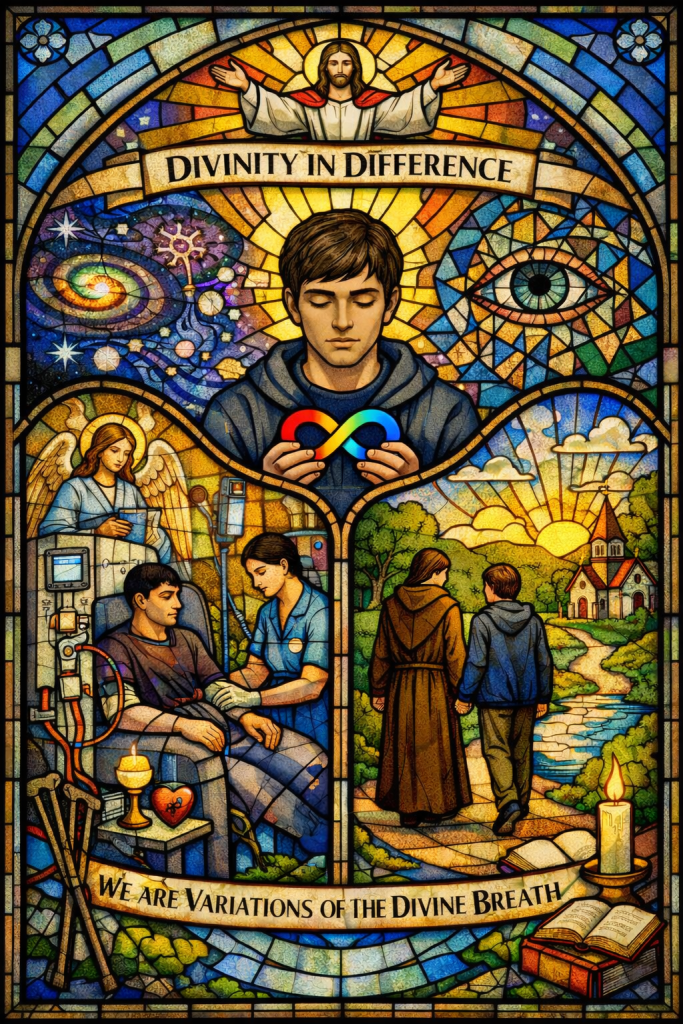
A large stained-glass window in rich jewel tones titled “Divinity in Difference.” At the top, Christ stands with arms outstretched in blessing beneath a golden halo and radiant light. In the center panel, a young person with closed eyes gently holds a rainbow infinity symbol, representing neurodiversity, surrounded by cosmic imagery—stars, planets, and intricate geometric patterns.
The lower left panel shows a dialysis scene: a dark-haired patient seated in a medical chair connected to a dialysis machine while a nurse carefully tends to their arm. An angel stands nearby reading from a book. A candle, a heart symbol, and medical equipment appear at the patient’s side, suggesting sacred ritual within medical care.
The lower right panel depicts a monk and a young person walking together along a winding path beside a river toward a small church at sunset, symbolizing spiritual companionship and steady routine. At the bottom of the window, a banner reads, “We Are Variations of the Divine Breath.”


 NeuroDivine
Leave a comment