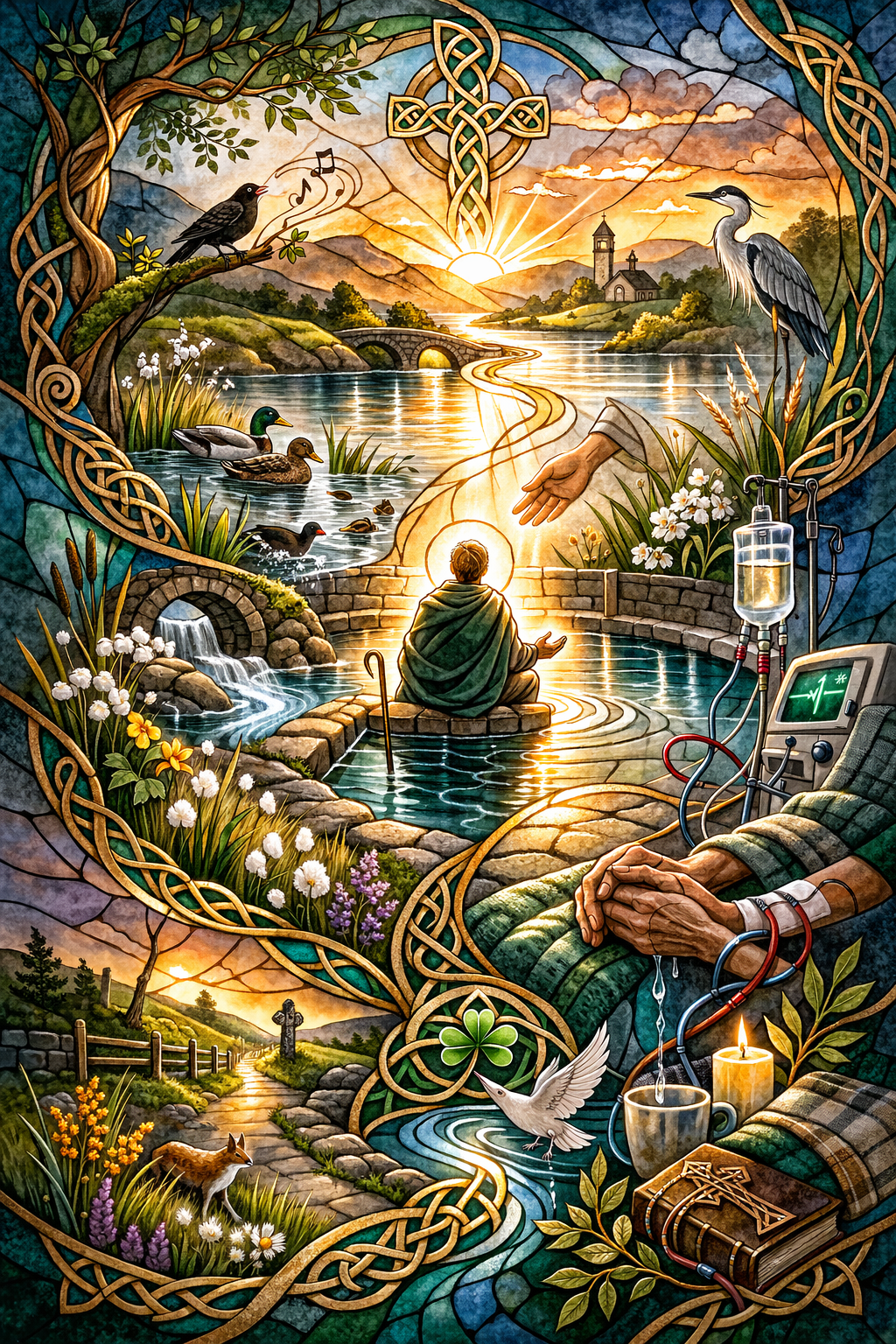
There are days when Jeremiah’s cry—“My anguish, my anguish!”—feels less like something from long ago and more like the body’s own truth. In the dialysis unit, with the soft beeping of the machines and the hush of people doing their best to get through another session, you can hear that same ache. Jeremiah speaks of a world coming apart at the seams; the body sometimes knows that feeling too.
And yet, even in the middle of all that, the Irish landscape offers a different kind of wisdom. On the walk in, the canal or riverbank is alive with its own quiet congregation: mallards tipping themselves head‑first into the water; coots skittering across the surface like they’re late for something; moorhens slipping in and out of the reeds as if they’re keeping the whole place running. A blackbird might still take up its place on a telegraph wire and sing as if the whole world depends on it. Bog cotton shivers in the breeze but doesn’t give in. The land knows how to bend without breaking.
The psalms for the evening—12 to 14—don’t bother with polite phrases or pretending everything is grand. They name the mess, the foolishness, the sense that goodness is scarce enough at times. They stand before God and say, “Here’s the truth of it.” There’s comfort in that kind of honesty. In a world full of noise, the psalms give permission to speak plainly, or to sit in silence when that’s all you can manage.
Then the Gospel brings us to the pool—a man waiting for years, watching others step ahead of him. There’s something very familiar in that waiting: the long hours in the dialysis chair, time measured not by the clock but by cycles, alarms, and the slow patience that keeps you going. The man by the pool isn’t dramatic. He just keeps turning up. He puts himself where healing might pass by.
When Jesus asks him, “Do you want to be made well?” it’s not about desire so much as readiness. Healing in this story isn’t earned; it’s encountered. It arrives the way a sudden break in the clouds does on a wet Irish afternoon—unexpected, but very welcome.
The land here understands that kind of grace. The hawthorn bursts into bloom after the hardest winter. The heron stands by the river, still as stone, waiting for what it cannot force.
The heron waits, yes—but it waits already equipped for flight. Waiting is not stagnation. It is readiness held quietly.
The fox moves through the long grass with the ease of something that knows exactly where it belongs. Nothing rushes. Nothing pretends. Everything is simply itself—and in that truthfulness, healing finds room to breathe.
Inside the dialysis unit, with the hum of machines and the fluorescent lights overhead, it can be hard to imagine that kind of spaciousness. But even there, small graces appear: a nurse who remembers your favourite blanket; the low murmur of someone’s radio; the way your breath eventually settles into the rhythm of the machine. They’re not dramatic miracles, but they’re real ones all the same.
Jeremiah teaches us to name the ache.
The psalms teach us to speak the truth without varnish.
The Gospel teaches us that healing often begins simply by being seen.
And Ireland—with its rivers, bogs, hedgerows, mallards, coots, moorhens, and stubborn wildflowers—teaches us that life keeps going, even when the ground feels uncertain underfoot.
Maybe that’s the invitation today:
to stand in the middle of whatever is unravelling, to wait by whatever pool we’ve been given, and to trust that the One who sees us still walks the roads of this island, still asks gentle questions, and still brings unexpected wholeness to those who keep showing up.
A Reflection on Jeremiah 4.19–end, John 5.1–18, and Psalms 12–14, the readings at Evening Prayer.

A richly detailed stained-glass artwork in Celtic style. At the center, a robed figure sits in a stone pool at sunset, facing a golden horizon beneath a Celtic cross, as a hand reaches toward him in blessing. Around the scene, an Irish river landscape unfolds with a stone bridge, small church, heron, blackbird, mallards, reeds, and wildflowers. On the right, a dialysis machine with tubing connects to resting hands, integrating hospital imagery into the sacred setting. At the bottom, a winding country path, Celtic knotwork, a fox, a dove, a candle, and a closed prayer book frame the scene. The colors are deep greens, golds, blues, and amber, evoking Irish landscape and stained glass.


 NeuroDivine
Leave a comment