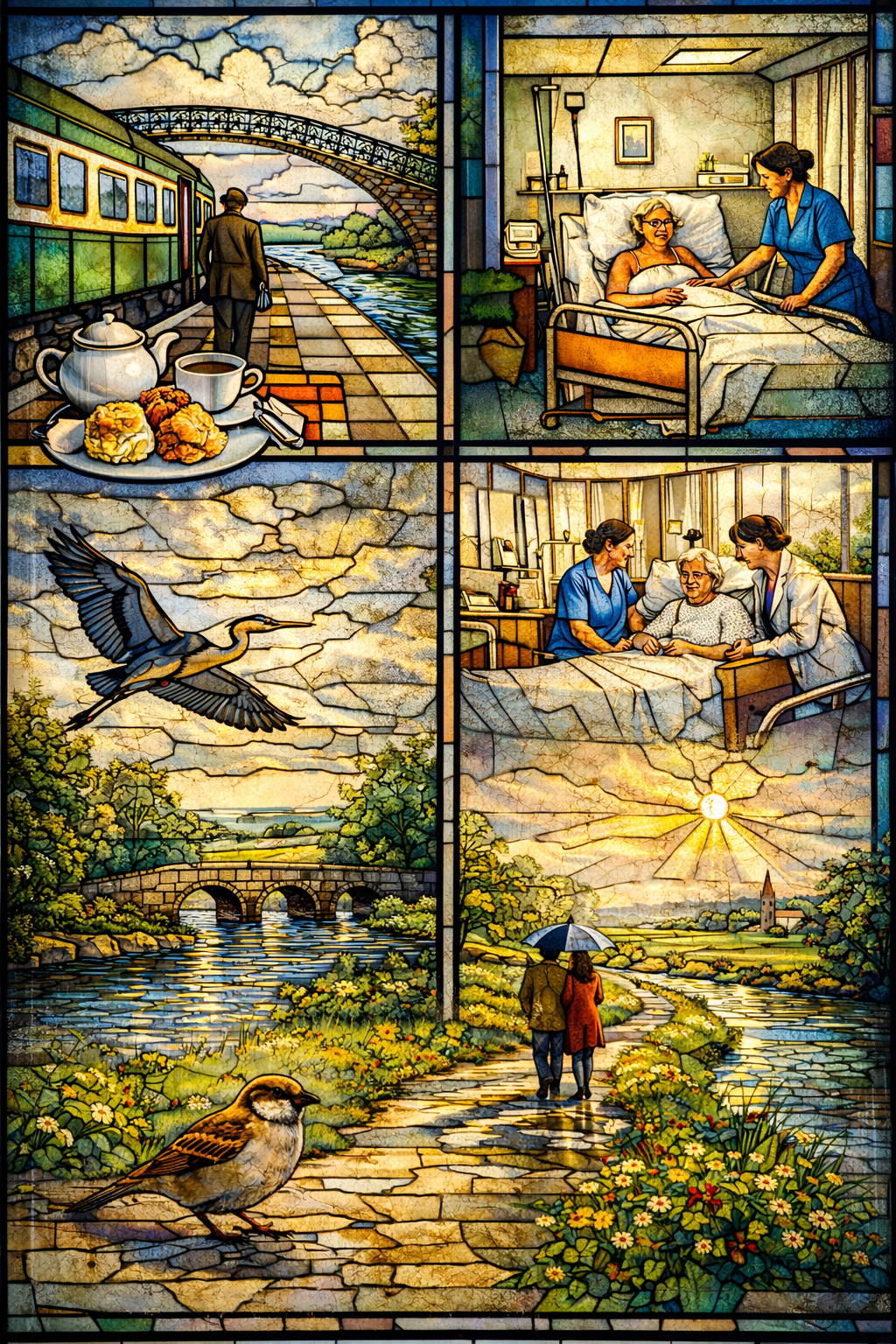
Arrival is a poem about coming home—not only to a place, but to a moment, a body, a ward, a riverbank, a sky clearing after rain.
Set along the familiar paths of Monasterevin and Ballybrittas, the poem moves through train platforms, hospital rooms, shared umbrellas, and sudden shafts of light. What might appear ordinary becomes luminous: tea poured, nurses greeting by name, a heron lifting into cloud, a sparrow steady on the path. Each scene offers a gentle revelation—that grace is not distant or dramatic, but woven into the everyday.
For those who live with vulnerability—of body, of mind, of circumstance—arrival can feel uncertain. Yet this poem suggests that even in places shaped by illness or waiting, love arrives first. Kindness gathers. Light breaks through. Life continues to assert itself in small mercies.
In the spirit of NeuroDivine, Arrival honours a sacred attentiveness—the kind that notices texture, tone, breath, and birdsong. It speaks to a spirituality grounded not in abstraction, but in presence. Here, the divine is encountered not beyond the world, but within it: in bridges crossed, in hands held, in skies returned to blue.
Arrival, the poem reminds us, is not the end of a journey. It is the grace of being met along the way.
I step down from the Monasterevin train,
The bridge stones warm with sun;
The river hums its low refrain—
A journey’s thread undone.
I taste the tea I longed to pour,
Fresh scones still breathing heat;
The clatter I once waited for
Now gathers round my seat.
I reach the ward where voices rise,
Familiar as my name;
The nurses greet with knowing eyes—
Today’s a gentler claim.
I find that love in quiet ways
Arrives before it’s sought;
In shared umbrellas, softened days,
And kindness freely brought.
I meet with God in sudden light
On roads near Ballybrittas;
A break in cloud, a heron’s flight—
Small mercies come to meet us.
I face down death without a dread,
For life keeps breaking through;
A sparrow on the path ahead,
A sky returned to blue.
And so I walk where rivers bend,
Where fields hold morning’s glow;
Arrival is the pilgrim’s friend—
A grace I come to know.
Copyright 2026 Michael McFarland Campbell.
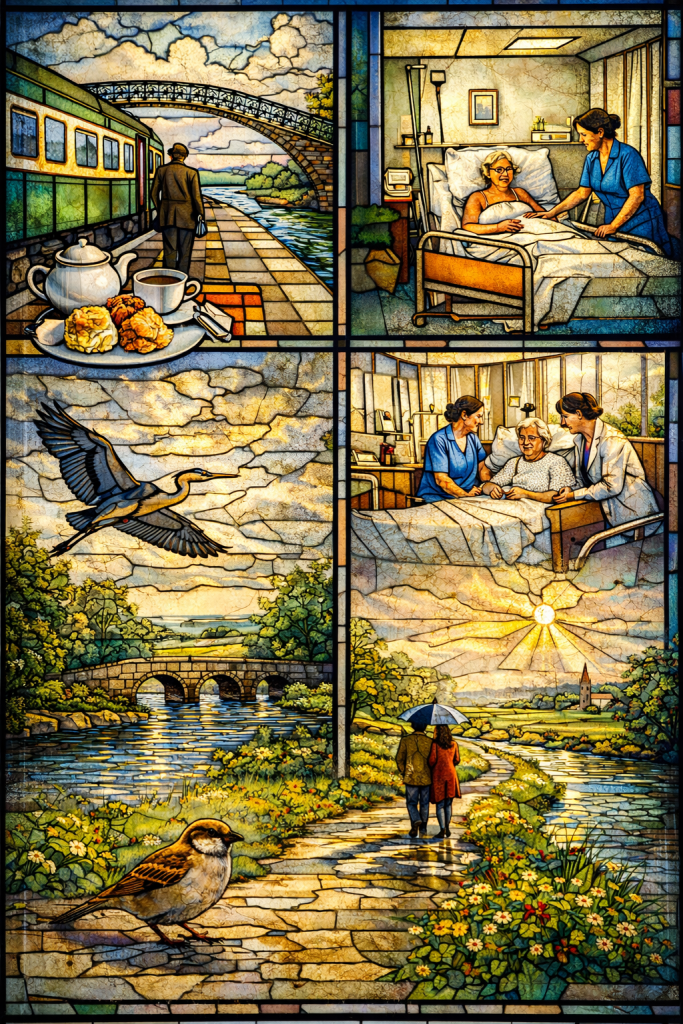
Alt-text: Stained glass artwork in four panels showing a man arriving by train beside a river, a nurse holding an elderly woman’s hand in a hospital ward, a heron flying over a stone bridge, and two people walking under an umbrella toward a sunlit countryside church. A sparrow and wildflowers fill the foreground, all rendered in rich jewel-toned glass with dark lead lines.


 NeuroDivine
Leave a comment