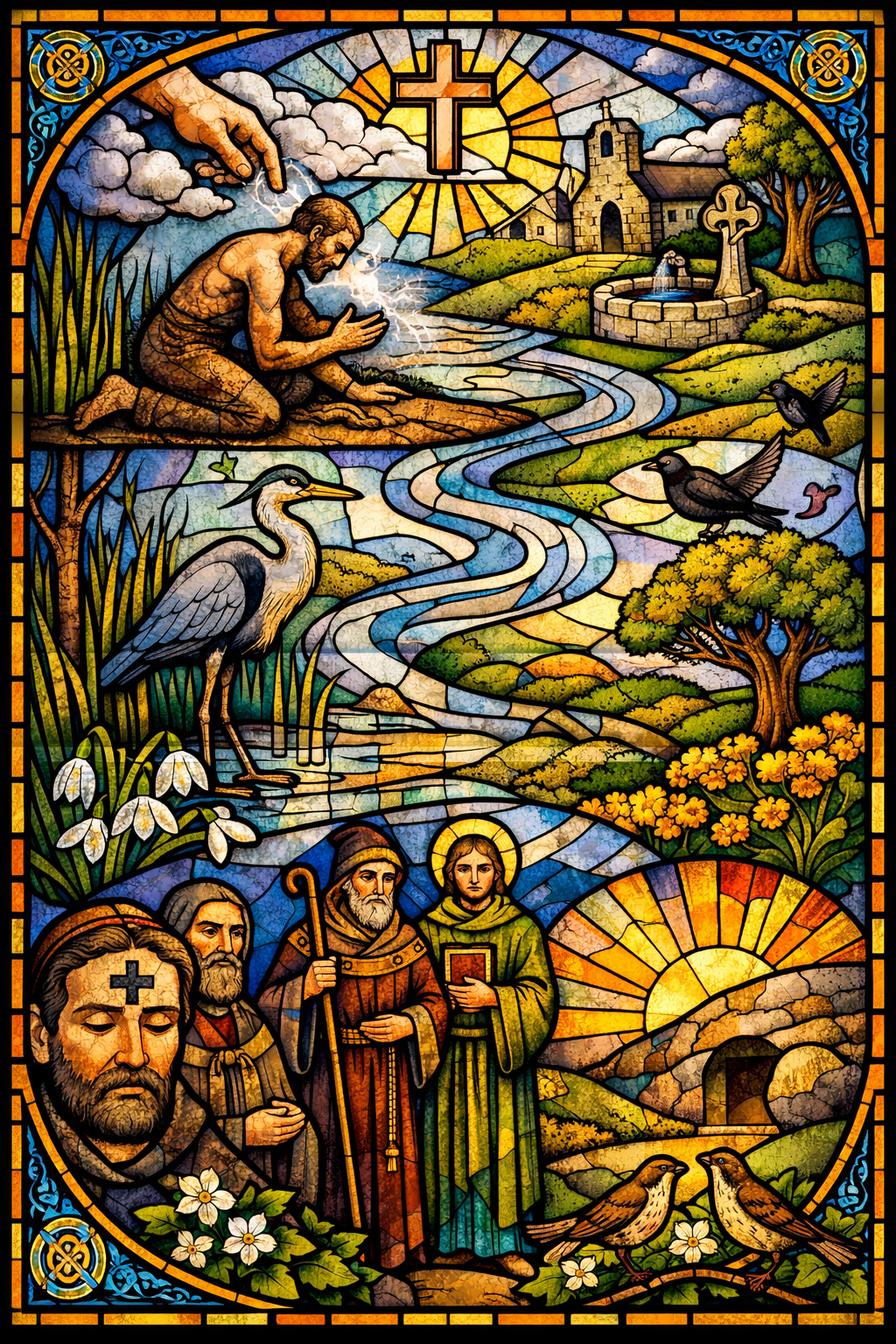
I wrote this hymn for Ash Wednesday out of a neurodivergent way of praying.
For many of us, faith does not begin in abstraction. It begins in texture. In the grit of ash against skin. In the sound of a river looping the same bend again and again. In the stillness of a heron that feels less like metaphor and more like kin.
“Remember that you are dust” can sound, in some theological tones, like diminishment. But from a neurodiverse spiritual lens, dust is not an insult—it is belonging. To be formed of earth is to be part of an ecosystem of grace. Clay is not a mistake. It is material chosen by God.
Ash Wednesday marks us publicly with frailty. For neurodivergent Christians, that visibility can resonate deeply. Many of us already live in bodies and minds that do not conform to dominant rhythms. We know what it is to be marked—sometimes misunderstood, sometimes misread. And yet the ash is not a mark of shame. It is a sacramental truth: you are finite, and you are held.
For me, this Ash Wednesday theology is not theoretical. Living with dialysis has made frailty unmistakably physical—time measured in treatments, strength that fluctuates, a body that depends on intervention to keep going. Three times a week, I am reminded that I am not self-sustaining. And yet dialysis is not only a sign of limitation; it is also a sign of persistence, of breath continuing, of life held in fragile but real continuity. In that way, it feels profoundly Lenten. Ash on the forehead and blood lines from the chest both tell the truth: I am dust. And still, God breathes. Still, life flows. Still, mercy draws near.
The Celtic theological imagination has always felt hospitable to this way of being. It does not rush to systematize. It attends. Rivers become teachers of repentance because they literally turn. Snowdrops proclaim resurrection because they pierce dark soil. The land is not illustrative; it is participatory.
In this hymn, I wanted to honour a spirituality of deep attention—the kind many neurodivergent people practice instinctively. Watching the Barrow wind slowly. Noticing gorse flare gold against stone. Standing with the heron in sustained stillness. This is not distraction from Lent. It is Lent.
Repentance, in this vision, is not moral panic. It is re-orientation. It is the gentle but persistent turning of the heart toward mercy—like a river finding its way home.
Ash tells the truth about limitation. Breath tells the truth about belovedness. Both are necessary. Both are holy.
My hope is that this hymn offers an Ash Wednesday that does not demand performance or emotional uniformity, but invites embodied, attentive return. Marked with ash, grounded in earth, accompanied by saints and skylarks, we walk the forty days not as problems to be fixed, but as creatures being breathed into again.
You might try praying the hymn slowly—even aloud—letting each image settle in the body. Notice the textures: dust, river, reed, flame, birdsong. Pause between verses. Breathe deeply. Allow the repetition of landscape and mercy to regulate the nervous system rather than rush it. Lent need not be driven or harsh. It can be steady, sensory, grounded—like a river winding patiently home.
From dust of earth and breath of God,
we rise to walk this Lenten way;
the ash of bog and blackthorn twig
reminds us we are formed of clay.
A heron stands in stillness deep
beside the reeds at break of dawn—
it calls us back to humble truth:
we journey held, yet frail, yet drawn.

The Barrow winds through rush and reed,
a pilgrim river, patient, slow;
its silver bends invite our hearts
to turn again, repent, and grow.
As snowdrops pierce the winter dark
and gorse lights gold on stony hill,
so Christ awakens hope in us—
a quiet flame no frost can kill.

O Christ who walked the western shore,
who blessed the well and oak and stone,
renew the covenant of grace
that binds our wandering hearts to home.
With saints who kept the Celtic flame
through storm and exile, night and fear,
we take the ash upon our brows
and trust your mercy drawing near.

So lead us through these forty days
with skylark hymn and blackbird psalm;
teach us the wisdom of the fields,
the penitence that births deep calm.
Till Easter breaks in dawnlit green
and thrushes praise the risen Lord,
may we, restored by earth and grace,
return to life in one accord.
Text copyright 2026 Michael McFarland Campbell. All rights reserved.
Alt text:
Stained glass window in Celtic style showing creation from dust, a heron by a winding river, Celtic saints with ash crosses, and an Easter sunrise over an empty tomb—framed in blue and gold


 NeuroDivine
Leave a comment